Backward Planning Examples: 5 Real Goals Mapped in Reverse
The best way to learn backward planning is to see it in action. Five real goals mapped in reverse, from the final outcome to that first 20-minute step today.
TL;DR: Backward planning works because it converts a vague ambition into a chain of concrete dependencies. Working backward from the outcome surfaces hidden prerequisites that forward planning misses. These five examples (saving $10k, planning a trip, changing careers, learning a language, and moving into van life) show the same method applied to different timelines. Each one starts the same way: with a number, a deadline, and a 20-minute first step.
See Backward Planning in Action
The easiest way to understand backward planning is to watch it unfold across different kinds of goals. The method never changes: start at the finish line and work backward until you reach a step you can take right now. But the milestones look different depending on the timeline and the stakes involved.
A 2017 study in Psychological Science (Park, Lu, and Hedgcock) found that people who planned backward completed more tasks and reported greater motivation, higher goal expectancy, and less time pressure than forward planners. The examples below show why: backward planning turns "I wish I could" into a numbered sequence of dependencies.
1. Save $10,000 in 12 Months
Outcome: $10,000 in savings by this time next year.
The backward chain:
- Month 12: $10k in the savings account
- Month 6: halfway checkpoint at $5k
- Month 1: automatic transfer of $833/month set up and running
- Week 1: track one normal week of spending to find the leaks
- Day 1: cancel 3 unused subscriptions (20 minutes)
The critical dependency surfaces in week 1. You cannot automate a realistic savings number until you know what you actually spend. That is why the first step is tracking, not setting up the transfer. The transfer number comes from the tracking, not from a guess.
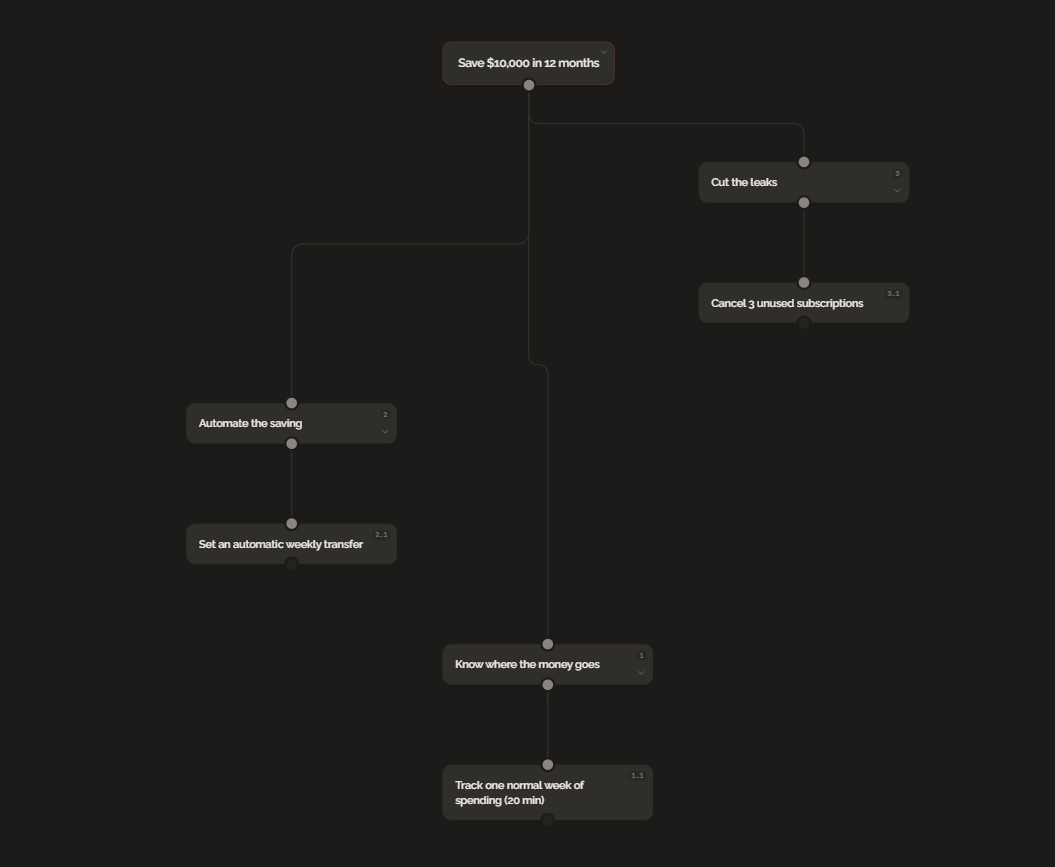
The full walkthrough with a complete tree is in our dedicated guide: how to save $10,000 with a backward plan.
2. Spend 3 Months in Southeast Asia
Outcome: Three months traveling Southeast Asia starting next winter.
The backward chain:
- Month 3: return flight home
- Month 2.5: final destination before flying out
- Month 1: first base settled (rental, SIM card, local transport figured out)
- Week -4: flights and travel insurance booked
- Week -8: total trip budget set and funded
- Day 1: shortlist 3 potential first-month bases (20 minutes)
The dependency most people miss. You need to know your first-month base before you can book a flight that makes sense. A cheap flight to Bangkok is useless if your first base is Chiang Mai and you are paying for an expensive last-minute connection. Pick the base, then book the flight.
The full tree walkthrough: how to plan 3 months in Southeast Asia backward.
3. Land a Role in a New Career
Outcome: Offer accepted in a new industry within 12 months.
The backward chain:
- Month 12: offer letter signed
- Month 10: final round interviews
- Month 8: applications out to target companies
- Month 6: portfolio or proof-of-work complete
- Month 3: target role and industry chosen
- Day 1: ask 3 people already doing the job for a 15-minute chat (20 minutes)
The dependency most people miss. You cannot build a portfolio for a role you have not defined yet. The informational interviews come first because they tell you what skills a credible portfolio actually needs. Most career changers start building first and researching second, which produces a portfolio that misses the mark.
Full guide: how to plan a career change backward.
4. Hold a 15-Minute Conversation in Spanish
Outcome: Fluent-enough conversation by June of next year.
The backward chain:
- June: hold a 15-minute unscripted conversation
- April: 50 tutoring sessions completed
- March: daily listening habit established (podcast during commute)
- February: core vocabulary of 500 words internalized
- Week 1: book the first tutor session (20 minutes)
The dependency most people miss. Language learning fails most often at the transition from input (reading, listening) to output (speaking). The backward plan puts the first tutor session in week 1 precisely to avoid months of passive input that never converts to speaking. The tutor forces output from the start.
Full guide: how to learn a language with backward planning.
5. Live on the Road Full-Time
Outcome: Living in the van, working remotely, by July next year.
The backward chain:
- July: hit the road
- May: van build-out complete
- March: van purchased and inspected
- January: remote income stable at $4k/month
- Today: set up automatic monthly savings transfer for the van fund (20 minutes)
The dependency most people miss. The van is exciting; the income is foundational. You cannot live on the road without a remote income stream that covers both life on the road and the mechanical surprises a used van throws at you. The backward plan surfaces this before you spend a dollar on the vehicle.
Full walkthrough: how to plan van life backward.
These five examples only scratch the surface. Your own goal has its own backward chain waiting to be mapped. Let GoalBranch generate it for you and see your first step in 60 seconds.
The Bottom Line
Every backward plan starts the same way: with a specific outcome, a real deadline, and a tiny first step you can take today. The goal does not matter: saving, traveling, career change, a new skill, or a lifestyle shift. The method is the same. Pick one of the examples above that feels closest to your situation, follow its backward chain, and take the 20-minute step at the bottom of the tree. That first step is all you need to start moving in the right direction.
FAQ
What is a good example of backward planning?
A concrete backward plan starts with the exact outcome and works backward through each milestone. Saving $10,000 in 12 months backward-planned looks like: $10k saved by month 12, $833/month automated by month 1, spending tracked today.
What are the steps of backward planning?
The method has five steps: define the specific outcome with a number and a deadline, identify what must be true just before the outcome, repeat backward through each milestone until you reach something you can do this week, build the full dependency tree, and execute that first small step.
Does backward planning actually work?
It does. The method replaces vague intention with a chain of specific questions: what must be true before each milestone, and what comes before that. A 2017 study in Psychological Science found that people who planned backward completed more tasks and reported greater motivation, higher goal expectancy, and less time pressure than forward planners.
Is backward planning the same as reverse goal setting?
Yes. Backward planning, reverse goal setting, and backcasting all describe starting at the finish line and mapping milestones in reverse. The five examples in this post show how that same structure applies across saving, travel, career, language, and lifestyle goals.
Ready to try backward planning on your own goals?
Start planning freeMore guides
Vision Board With Goals: Attach a Step to Every Image
Most vision boards show dreams without the steps to reach them. Here is how to attach a backward plan to every image and turn your board into a real roadmap.
Backward Design vs Backward Planning: Same Idea, Different Rooms
Backward design and backward planning share one logic: start at the outcome and work back. One belongs to education, the other to goals. See how they compare.