How to Learn a Language: A Backward Plan From Conversation Day
Most language plans start with an app and hope for the best. Backward planning starts at the conversation you want to hold and works back to today. Here's how.
TL;DR: Most language learners sign up for an app, do a few lessons, and stall. The problem isn't motivation; it's that the plan starts at today instead of the finish line. Backward planning flips this: decide what you want to be able to do (hold a 15-minute conversation, order food, give a presentation), then work backward from that date to find your first 20-minute step. The result is a plan where every session exists because the goal needs it.
Why Language Goals Need Backward Planning
The default language learning plan looks like a list of apps and resources. Duolingo for vocabulary. A podcast for listening. Maybe a tutor once a week. It sounds productive, but it has no anchor. You study what feels reasonable today instead of what moves you toward a specific conversation.
Backward planning replaces this with a single question: what do you want to be able to do, and by when? The answer becomes your anchor. Every study session either serves that date or it doesn't. The same approach works for other big goals, and it's covered in more detail in our guide on how to break a big goal into small steps.
Step 1: Pick the Conversation You Want to Hold
Be specific about the outcome. Vague goals produce vague plans.
Weak: "Learn Spanish" Strong: "Hold a 15-minute conversation in Spanish by June"
Include the skill, the context, and the deadline. The skill is what you will actually do (hold a conversation, not "learn" in the abstract). The context keeps it realistic (a conversation, not fluency). The deadline makes it real.
If you are traveling, the goal might be "order food and ask for directions in Thai by November." If you are reconnecting with family, it might be "tell a family story in Italian at the December reunion." Make it specific enough that you will know without doubt whether you hit it.
Step 2: Map the Milestones Backward
Starting from your conversation date, ask what must be true just before.
A chain for the Spanish example:
- June: Hold a 15-minute conversation
- Before that: Comfortable with 5 common conversation topics (introductions, work, travel, food, hobbies)
- Before that: Can speak in full sentences on familiar topics
- Before that: Know 500+ core words and basic sentence structure
- Before that: Daily listening and reading habit established
- Before that: Choose one podcast and one app for daily input
- Today: Book the first tutor session for speaking practice
Each answer becomes a milestone. Keep going until you reach something you can do in 20 minutes. That first step is the only thing you need to think about today.
Step 3: Identify Dependencies
Backward planning surfaces the hidden prerequisites that forward planning misses.
You need speaking practice before you can hold a conversation. Most learners spend months on apps and never speak. The backward plan reveals this on day one because the goal is literally a conversation. The first milestone becomes finding someone to talk to.
You need input before you can produce. You cannot speak sentences you have never heard. The plan needs a daily input habit (podcasts, reading, video) that starts long before your first conversation attempt.
You need core vocabulary before input makes sense. Listening to a podcast at zero vocabulary is noise. Build the first 200-300 words first through an app or flashcards, then layer in listening.
These dependencies are why sequential forward plans fail. You study vocabulary for weeks, then realize you should have been listening all along. Backward planning catches this at the start.
Step 4: Build Your Tree
Each milestone becomes a branch of your tree. Each branch has its own sub-steps.
For the "speaking practice" milestone, the branches might be:
- Book a tutor for weekly sessions
- Learn 10 conversation starter phrases
- Practice introducing yourself aloud
For the "daily input habit" milestone:
- Pick one podcast for learners (15 minutes daily)
- Find a graded reader at your level
- Set a daily 10-minute reading reminder
GoalBranch handles this structure automatically: type your goal and it generates the tree. You can expand any branch, regenerate sections, and see the whole picture on an infinite canvas.
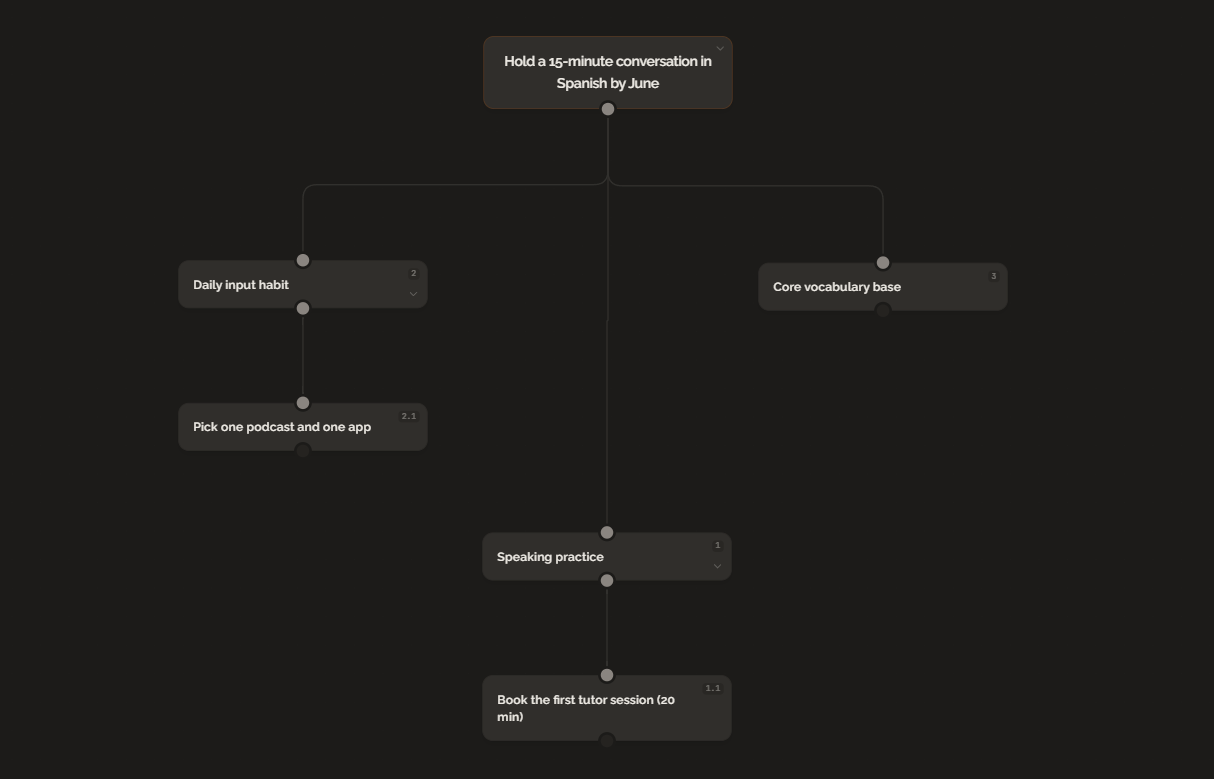
This tree shows a language goal planned backward. The first branch (speaking practice) has the smallest first step: book a 20-minute tutor session. Everything above it depends on something below. Build your own tree, or generate yours automatically and see your first step in 60 seconds.
The same method works for planning a trip. See how it applies to a 3-month Southeast Asia itinerary for another worked example.
Step 5: Take the First 20-Minute Step
The last milestone in your backward plan is your starting point. For the language example, it is booking a trial tutor session on a platform like italki or Preply.
This step is deliberately small. Twenty minutes is enough to browse tutors, read reviews, and book one session. The session itself creates a deadline: you now have someone expecting you to show up and speak next week. That external commitment is stronger than any streak counter.
If booking a tutor feels too early, your first step might be simpler: install a flashcard app and learn 10 words today. Or find the podcast you will use for daily listening. The rule is the same: pick the smallest version of the first step and do it now. A backward plan for saving $10k uses the same 20-minute-first-step pattern with a different goal.
The Bottom Line
Language learning stalls not because the goal is hard, but because the plan starts in the wrong place. Start at the conversation you want to hold and work backward to the 20-minute step sitting in front of you. That first session is closer than you think.
FAQ
How do I start learning a language from scratch?
Start at the conversation you want to hold, then work backward. Pick a concrete goal ("hold a 15-minute conversation in Spanish by June"), map the milestones backward from that date, and identify what you need in place at each stage. The first step should take 20 minutes.
What is a backward plan for learning a language?
A backward plan for language learning starts at the target conversation date and works backward through speaking practice, daily input habits, and core vocabulary. Each milestone is a prerequisite for the one after it, so every study session exists because the goal needs it.
How long does it take to learn a language with backward planning?
The timeline depends on your goal and consistency. A conversational milestone like holding a 15-minute conversation is achievable in 3-6 months with daily practice. The backward plan itself takes about 20 minutes to create.
Is backward planning better than a study schedule?
A study schedule tells you what to do each day. Backward planning tells you why you are doing it. The schedule is the output of the plan, not the plan itself. A 2017 study in Psychological Science found that backward planners completed more tasks and reported greater motivation and less time pressure than forward planners.
Ready to try backward planning on your own goals?
Start planning freeMore guides
How to Get Your First Freelance Client: Work Backward From the Invoice
Landing your first freelance client is a chicken-and-egg problem. Working backward from a clear invoice gives you a concrete path from zero to paid work.
How to Plan a Career Change Backward (Without Quitting Blind)
Backward planning for a career change starts with the target role, not the resume. Here is how to plan a career pivot step by step, with a real example tree.