How to Plan 3 Months in Southeast Asia, Backward
Three months in Southeast Asia is a dream that needs a plan. Here is how to backward-plan the route, budget, and timeline so your trip actually happens.
TL;DR: Planning 3 months in Southeast Asia stalls when you start from "what do I need to pack." Backward planning flips the direction: start at your departure date and work backward through route, budget, visas, and vaccinations until you reach one step you can do in 20 minutes. One tree can hold the whole plan, and the first step is shorter than an episode of your favorite show.
The Backward Plan for a 3-Month Trip
The reason most people dream about 3 months in Southeast Asia but never book it is not the cost. It is the number of choices. Which countries. What route. How much money. When to go. Forward planning tries to answer every question at once and produces analysis paralysis.
Backward planning breaks the paralysis. Start with the one date you control (your departure), then ask what must be true in the weeks and months before it. Each answer is a milestone. Keep going until you reach something you can do right now.
The method comes from an old book, and research backs it up. A 2017 study in Psychological Science (Park, Lu, and Hedgcock) found that people who planned backward completed more tasks and reported greater motivation, higher goal expectancy, and less time pressure than forward planners. The principle applies whether the goal is a van build or a visa run.
Step 1: Pick the Route Before Anything Else
Choose one direction and a rough country order. Nothing else matters until you know the shape of the trip. The classic Banana Pancake Trail covers the four countries that have the best infrastructure for solo travelers:
Thailand (3 to 4 weeks). Start in Bangkok, head north to Chiang Mai and Pai, then down to the southern islands. Thailand has the most developed backpacker infrastructure and the widest range of accommodation.
Laos (2 weeks). Luang Prabang, Vang Vieng, and the slow boat down the Mekong. Laos is the cheapest country on the route and the most laid back.
Vietnam (3 weeks). Hanoi, Ha Long Bay, Hoi An, and Ho Chi Minh City. Vietnam is the most geographically varied and the food alone justifies the trip.
Cambodia (2 weeks). Siem Reap for Angkor Wat and Phnom Penh for the riverfront. Cambodia pairs history with some of the best island beaches in the region.
Add Indonesia, Malaysia, or the Philippines if your timeline stretches past 90 days. Pick the route first because visa requirements, internal flight costs, and seasonal weather all depend on it.
Step 2: Work Backward From Departure Day
Once you have a route, anchor everything to your departure date. For a November start (dry season across all four countries), the backward chain looks like this:
- 1 week before: Pack, notify your bank, download offline maps for each country
- 2 weeks before: Book first 3 nights of accommodation, buy travel insurance, install eSIM
- 3 weeks before: Apply for e-visas (Vietnam and Cambodia take 3-5 business days)
- 1 month before: Book international flights and the first internal flight
- 2 months before: Check passport validity (needs 6 months beyond your return date), get recommended vaccinations, order any gear
- 3 months before: Set the total trip budget number and start automatic savings transfers
The items with the longest lead times are the ones most forward planners miss. Passport renewal. Vaccination appointments. Visa processing windows. Backward planning surfaces these as dependencies early, exactly as it does for van life or any big life goal.
Step 3: Set the Budget as One Number
Vague budgets produce overspending. "As cheap as possible" is not a number. Work backward from a total you can actually save.
A realistic all-in budget for 3 months in Southeast Asia:
- Daily on-the-ground costs: $30 to $50 per day ($2,700 to $4,500 for 90 days)
- International and internal flights: $300 to $600
- Visas: $100 to $200
- Travel insurance: $100 to $200
- Gear: $200 to $400
- Emergency buffer: $300 to $500
Total range: $3,700 to $6,400. That includes accommodation, food, transport, activities, and all the hidden costs. If the total does not fit your timeline, the backward structure shows you exactly which lever to pull: a shorter trip, cheaper countries, or fewer internal flights.
The Real Example: A 3-Month Tree
Here is the same plan as a GoalBranch tree. Each branch is one phase of the trip; each sub-step is something you can do this week.
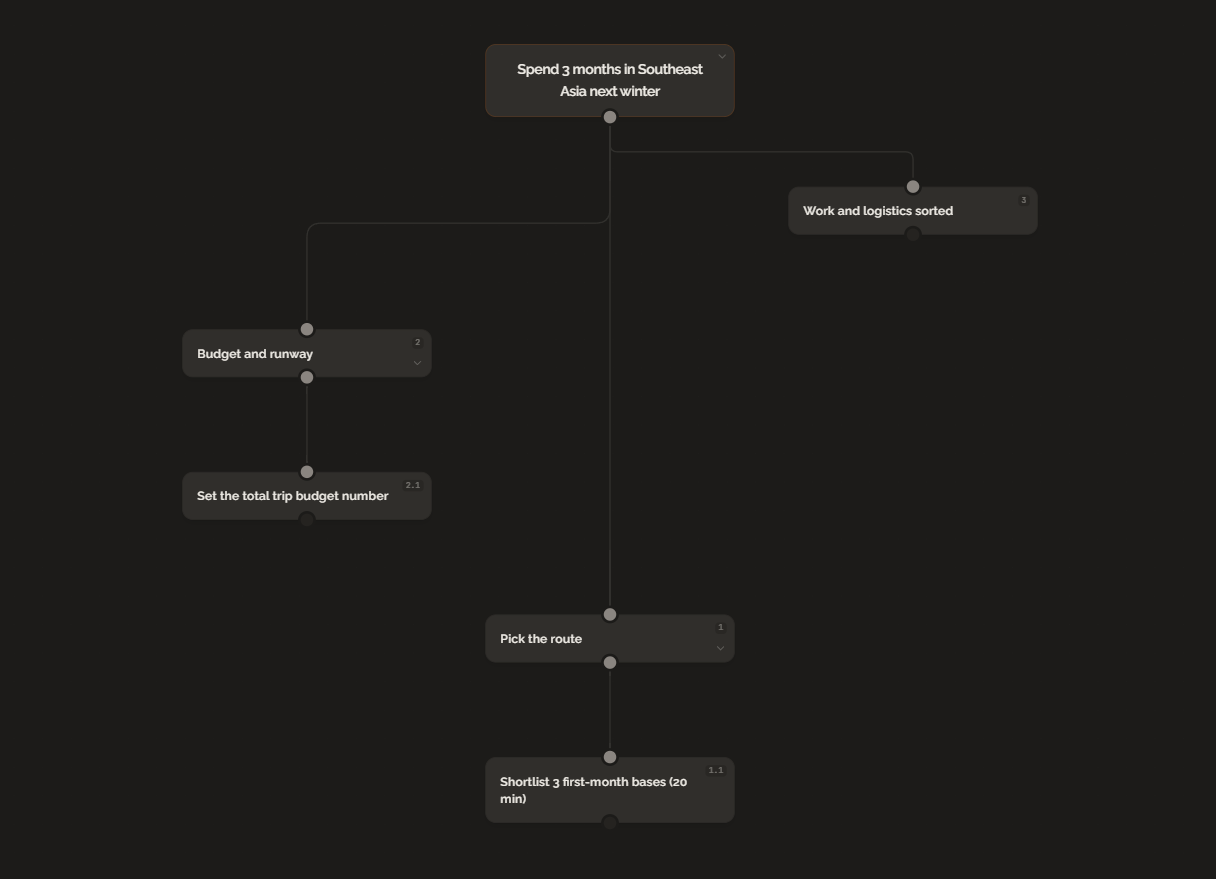
The tree starts at the goal and branches into three priorities:
Pick the route. The first sub-step is "Shortlist 3 first-month bases." That takes 20 minutes. Open a map, pick three cities in your first country, and suddenly the trip has a shape. Everything else builds from that choice.
Budget and runway. The sub-step is "Set the total trip budget number." One number, not a range. That number anchors every decision from accommodation grade to whether you fly or bus between countries.
Work and logistics sorted. Covers everything with a lead time: remote income, visa applications, gear, and the return flight. In a tree, these items sit at the level their deadlines demand, not buried in a spreadsheet.
The tree also makes dependencies visible. If your passport expires before the trip, that branch turns red months before departure instead of the week before. That is the advantage of a visual plan over a to-do list, and it is the same reason breaking a big goal into small steps works best when you can see how each piece connects.
Build Your Own Tree
The example above is a starting point. Your route, budget, and timeline will be different, and that is fine. A generic itinerary gives you a PDF; a backward-planned tree gives you a living plan you can expand and adjust as things change.
You can sketch this on paper, or generate yours automatically and see your first step in 60 seconds.
The Bottom Line
A 3-month trip through Southeast Asia fits on one backward-planned tree. Start at your departure date, pick a route, set one budget number, and handle the dependencies with the longest lead times first. Your first step is shortlisting three bases for the first month. That takes 20 minutes.
FAQ
How much does 3 months in Southeast Asia cost?
A realistic all-in budget for 3 months in Southeast Asia is $3,700 to $6,400 depending on your route, accommodation style, and how much you fly between countries. Daily on-the-ground costs run $30 to $50 in most destinations.
What is the best route for 3 months in Southeast Asia?
The classic Banana Pancake Trail covers Thailand, Laos, Vietnam, and Cambodia. Three months is the sweet spot, long enough to slow down in each country and short enough that you do not burn out.
When is the best time to travel Southeast Asia for 3 months?
November through February is dry season across most of the region. It is peak season, so accommodation costs more, but the weather is reliable across all four countries on the classic route.
What is the first step in planning a 3 month trip to Southeast Asia?
The first step is not booking a flight. It is shortlisting three cities for your first month. That takes 20 minutes and turns a vague dream into a concrete destination. Everything else builds from there.
Ready to try backward planning on your own goals?
Start planning freeMore guides
How to Get Your First Freelance Client: Work Backward From the Invoice
Landing your first freelance client is a chicken-and-egg problem. Working backward from a clear invoice gives you a concrete path from zero to paid work.
How to Plan a Career Change Backward (Without Quitting Blind)
Backward planning for a career change starts with the target role, not the resume. Here is how to plan a career pivot step by step, with a real example tree.