Backward Design vs Backward Planning: Same Idea, Different Rooms
Backward design and backward planning share one logic: start at the outcome and work back. One belongs to education, the other to goals. See how they compare.
TL;DR: Backward design (education) and backward planning (goal-setting) are the same method with different labels. Both start at the desired outcome and work backward to identify what must happen before. In education, the framework follows three formal stages: identify desired results, determine acceptable evidence, plan activities. In personal or professional goal-setting, the logic is called backward planning or reverse goal setting. The shared principle, validated by a 2017 study, is the same: the destination designs the route.
What Is Backward Design?
Backward design is a curriculum planning framework introduced by Grant Wiggins and Jay McTighe in their book Understanding by Design. It reverses the traditional lesson-planning sequence. Instead of starting with a textbook chapter, a favorite activity, or a list of content to cover, the teacher starts with the learning goal.
A typical classroom planning sequence goes: pick a topic, plan an activity, create a test. The test may or may not measure what was taught, because the goal was never stated first. Backward design replaces this with three stages:
Stage 1: Identify desired results. What should students know, understand, and be able to do by the end of the unit? These learning objectives come from standards, curriculum requirements, or the teacher's own judgment about what matters most.
Stage 2: Determine acceptable evidence. How will the teacher know if students have actually learned it? This means designing assessments, tests, projects, performances, or observations that demonstrate the learning objectives have been met.
Stage 3: Plan learning experiences and instruction. Only after the first two stages does the teacher design lessons, activities, and materials. The activities now exist because the learning goal and the assessment both demand them.
The result is a curriculum where every lesson is necessary. Nothing is included because it is fun or traditional or in the textbook. It is included because it moves students toward a clearly defined outcome. That is the same logic captured in our backward planning glossary entry: the outcome comes first, the steps follow.
What Is Backward Planning?
Backward planning applies the same logic outside the classroom. It is the general method of starting at any desired outcome and working in reverse through milestones to identify what must happen before each one. In goal-setting contexts, it is also called reverse goal setting or backcasting.
The core questions are the same but reframed for personal or professional goals:
- What does success look like?
- What must be true the week before I reach it?
- What must be true the month before that?
- What can I do today that the goal requires?
This method is covered in practice in our guide for backward planning for students, where it is applied to exams and grad school applications. The logic is identical to backward design, with the same emphasis on surfacing dependencies early. A student planning an exam backward discovers the same thing a teacher planning a unit backward discovers: the assessment determines the work.
Side-by-Side: The Disambiguation Table
| Aspect | Backward Design | Backward Planning |
|---|---|---|
| Primary domain | Education / curriculum | Goal-setting / productivity |
| Origin | Wiggins & McTighe, 1998 | Older, used across fields |
| Core question | "What should students learn?" | "What outcome do I want?" |
| Output | Unit plans, lessons, assessments | Step-by-step plans, task lists |
| Formal stages | Three (results, evidence, activities) | Flexible, varies by context |
| Dependency style | Standards and assessments | Milestones and prerequisites |
| Typical user | Teachers, instructional designers | Anyone with a goal |
The two frameworks converge on the same insight: forward planning drifts because it starts with activity instead of outcome. A 2017 study in Psychological Science (Park, Lu, and Hedgcock) found that people who planned backward completed more tasks and reported greater motivation, higher goal expectancy, and less time pressure than forward planners.
Whether you call it backward design or backward planning, the mechanism is the same: anchor to the outcome, then work backward. See your first step in 60 seconds.
Why the Distinction Matters
The two terms survive separately because they serve different audiences. A teacher searching for lesson-planning frameworks will find "backward design" in education journals and professional development courses. A professional or student searching for a productivity method will find "backward planning" in goal-setting books and blogs. They arrive at the same practice through different doors.
Understanding both terms makes the method more portable. A teacher who knows backward design can apply it to personal goals by reframing the learning objective as a personal outcome and the assessments as milestones. A professional who knows backward planning can apply it to curriculum design by treating each lesson as a step toward the learning outcome. The method does not care which room you are in.
Real Example: A Final Exam, Planned Backward
Here is a backward plan for an academic goal built in GoalBranch:
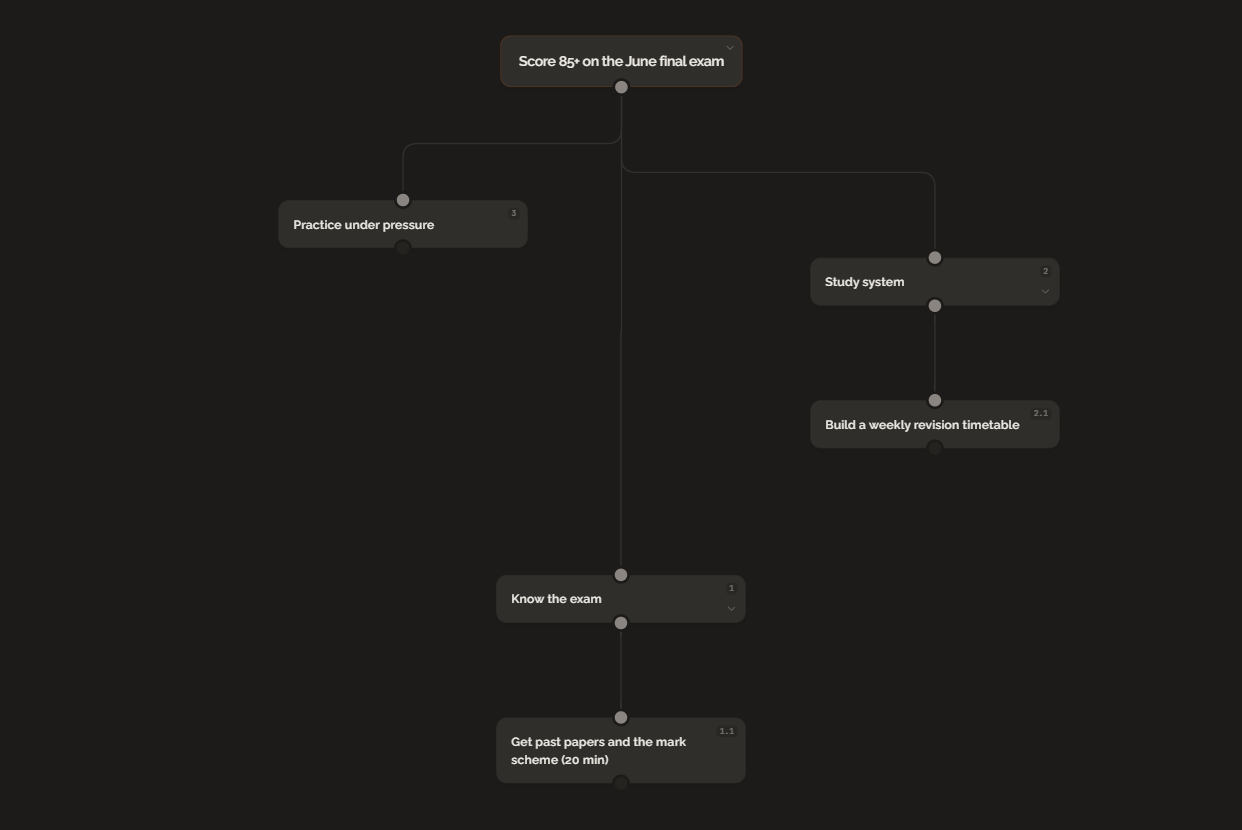
This tree is a backward plan for a student goal. The same structure maps directly onto backward design for a teacher planning the same unit:
- Desired result: Students score 85+ on the June final exam.
- Acceptable evidence: The exam itself plus practice tests that validate each topic area.
- Learning activities: The study system branch (revision timetable) and the practice-under-pressure branch (timed exams).
The teacher using backward design would identify the practice tests as the assessment (stage 2) before designing the weekly revision schedule (stage 3). The student using backward planning would identify the same steps in the same order, just without the formal framework labels.
The 20-minute first step, getting the past papers, is both a study plan action for the student and the first assessment design task for the teacher. The destination draws the route in both cases.
The Bottom Line
Backward design and backward planning are the same mental move with different labels for different audiences. One belongs to education, with a formal three-stage framework. The other belongs to personal and professional goal-setting, with a flexible structure that fits any outcome. Both work because the outcome comes first and the route follows.
FAQ
What is backward design in education?
Backward design is a curriculum planning framework developed by Grant Wiggins and Jay McTighe. It starts with desired learning outcomes and works backward through assessments to lesson plans. It is backward planning applied to teaching.
What are the three stages of backward design?
The three stages are: identify desired learning results, determine acceptable evidence of learning through assessments, and plan learning activities and instruction. Every lesson exists because the learning goal requires it.
Is backward design the same as backward planning?
They share the same logic: start at the desired outcome and work backward to identify prerequisites. Backward design is the term used in education and curriculum development. Backward planning is the broader term used in goal-setting, productivity, and project management.
How is backward design different from traditional lesson planning?
Traditional lesson planning starts with content or activities and hopes they lead to learning. Backward design starts with the learning goal first, then designs assessments and activities to meet that goal. The destination drives the route.
Ready to try backward planning on your own goals?
Start planning freeMore guides
Vision Board With Goals: Attach a Step to Every Image
Most vision boards show dreams without the steps to reach them. Here is how to attach a backward plan to every image and turn your board into a real roadmap.
How to Plan a Goal When You Don't Know the Steps
You don't need to see the whole path to start a goal. Backward planning turns unknown steps into research questions and gives you a way forward starting today.