How to Plan Van Life Backward: From Dream to First Step
A backward van life plan that starts at the finished goal and works backward to your first real step. No build experience or expensive tools required.
TL;DR: Van life is a long dream for most people because the steps feel impossible to map. Backward planning inverts the problem: start at the finished goal and work back to a single step you can take today. This post walks the method with a van life example you can apply directly.
Why Van Life Needs Backward Planning
The default way to plan van life is forward: save some money, browse van listings, buy something, figure out the build as you go. This is how most people stall. The goal is too big to act on, so they consume content instead of making decisions.
Backward planning flips the direction. Start with the finished outcome (say, "living on the road full-time by July 2027") and ask what must be true just before that. Each answer becomes a milestone. Keep asking until the answer is something you can do this week. The method comes from an old book, and research backs it up: a 2017 study in Psychological Science (Park, Lu, and Hedgcock) found that people who planned backward completed more tasks and reported greater motivation, higher goal expectancy, and less time pressure than forward planners. If the concept of breaking a big goal into smaller pieces is new to you, see how to break a big goal into small steps for the general method.
Step 1: Define the Outcome
Van life dreams are usually vague. "I want to travel." "I want freedom." Vague goals produce vague plans that never start.
Get specific:
Weak: "Buy a van and travel" Strong: "Live on the road full-time by July 2027, with $15,000 saved for the van, $5,000 for the build, and a remote income of $2,000 per month"
The strong version has numbers, a deadline, and a definition of success. Every decision you make will flow from these numbers.
Step 2: Map the Milestones Backward
Starting from your outcome, ask what must happen just before it:
- Before July 2027 on the road -> van built and road-ready by June 2027
- Before van is built -> electrical, insulation, bed, and kitchen installed by May 2027
- Before the build starts -> van purchased and inspected by March 2027
- Before buying a van -> financing arranged and $20,000 saved by February 2027
- Before saving $20,000 -> monthly savings target set and automatic transfers active from now
Each answer becomes a milestone. The chain converts a years-away dream into a concrete sequence with clear dependencies.
Step 3: Identify Dependencies
Backward planning surfaces the hidden blockers that forward planning misses:
Your income. Van life without a remote income or a runway is a countdown. If you need to switch careers or build a freelance income, that dependency goes before the van purchase, not after.
Your timeline. National parks and popular campgrounds can book out months ahead. If you want to be at a specific place by a specific date, the booking window determines your start.
Your vehicle. The right van depends on everything else: how tall you are, how much power you need, where you plan to go. Buying a van before you know these answers leads to expensive mistakes.
Your skills. If you have never used a drill, a full custom electrical system is not a weekend project. Your skill level should influence your build plan, not stop you from starting.
Step 4: Build Your Tree
Each milestone becomes a branch. For "van purchased and inspected" you might branch into:
- Saved $20,000 -> set monthly automatic transfers -> adjust budget -> cut 3 expenses
- Researched platforms -> compare Ford Transit vs Ram ProMaster vs Mercedes Sprinter -> read owner forums -> visit a dealer to sit in each
- Found listings -> set alerts on 3 marketplaces -> inspect 5 vans in person -> book pre-purchase inspection
- Made an offer -> negotiate based on inspection findings -> arrange insurance and registration -> drive it home
Each branch splits into smaller branches until every step takes under 30 minutes.
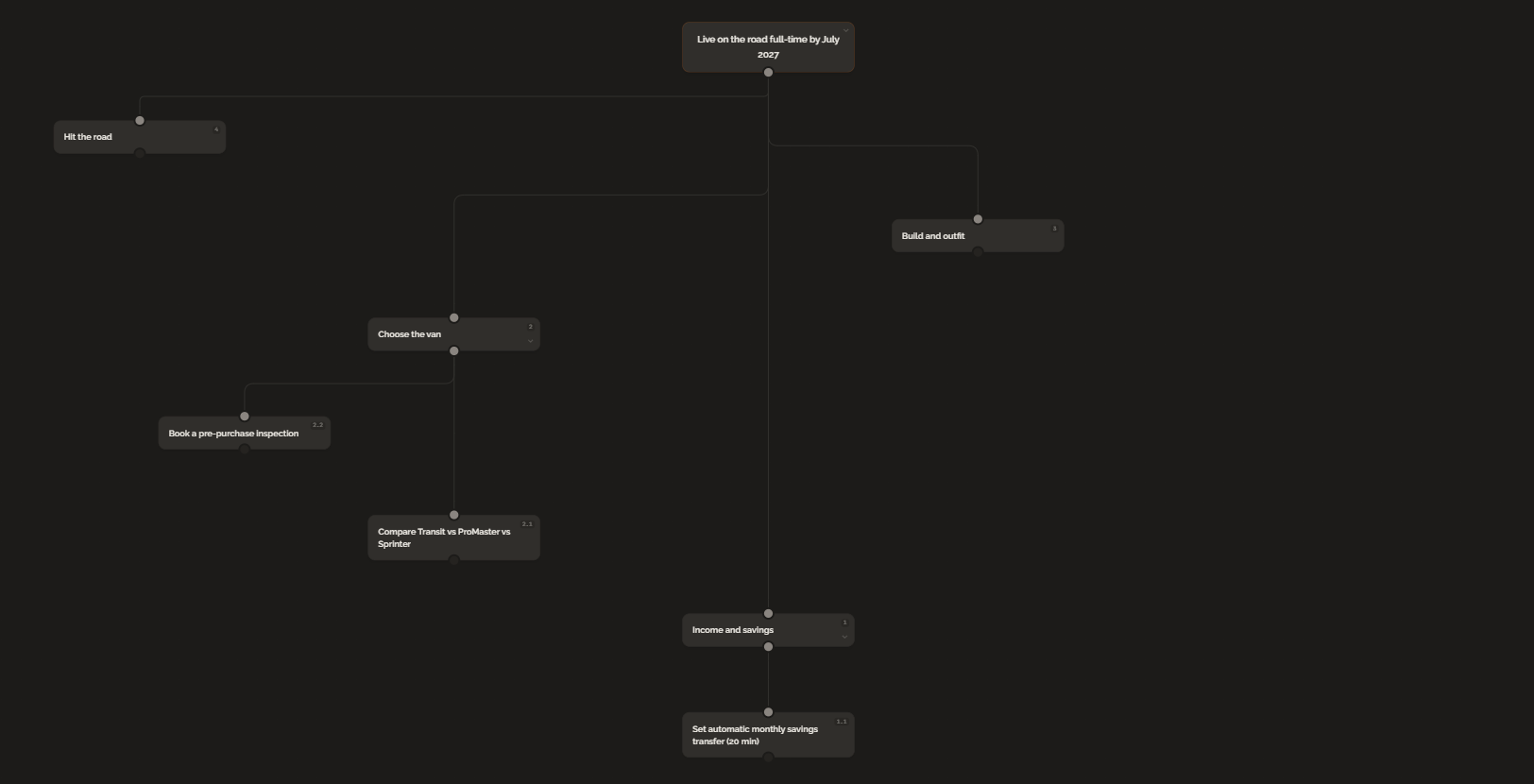
GoalBranch does this mapping automatically. You type your goal, and it generates the tree. You can expand any branch, regenerate sections, or generate yours automatically and see your first step in 60 seconds.
Step 5: Execute the First Step
The last milestone in your backward plan is your starting point. For van life, that first step is almost never buying a van. It is something concrete and small:
- Set up a monthly automatic transfer to a dedicated van fund
- Rent a camper van for a weekend to test the lifestyle
- Spend one evening comparing the Ford Transit, Ram ProMaster, and Mercedes Sprinter dimensions
- Book a pre-purchase inspection on a listing you have been watching
The step should take no more than one evening. If it feels too big, break it down further.
Step 6: Do a Shakedown
Van life is full of things you cannot plan for. The way to handle this is to build a shakedown trip into your backward plan: a short trip close to home after the van is minimally built, before you commit to full-time travel.
A weekend trip will teach you more about your layout, your power needs, and your tolerance for small spaces than any amount of research. Build what you learn back into the plan.
Real Example: Full-Time Van Life in 6 Months
Goal: Live on the road full-time with a remote income, starting January 2027
Backward plan:
- Month 6 (January 2027): On the road. Remote income at $2,000/month. Emergency fund in place.
- Month 5: Shakedown trip complete. Systems tested and adjusted. Mail forwarding and domicile sorted.
- Month 4: Build phase. Bed, insulation, electrical, kitchen, and storage installed. Roof fan and solar panels mounted.
- Month 3: Van purchased and pre-purchase inspection passed. Insurance active. Registration transferred.
- Month 2: Savings milestone reached. Backup income verified. Final van model chosen. 4 vans inspected.
- Month 1: Monthly automatic savings transfer started. Expenses reviewed and 3 subscriptions cut. Budget drafted. Camper van rented for a weekend test.
Each of these phases breaks into smaller steps. The real first step is "Set automatic savings transfer." It takes 20 minutes.
The Bottom Line
Van life is not one big decision. It is a chain of small, dependent decisions. Backward planning reveals the chain and surfaces the blockers that forward planning hides. The same method works for other personal goals too, from fitness to savings to career changes as shown in backward planning for personal goals. Start at the road, work back to today, and do the one thing that moves you toward it.
FAQ
How much does van life actually cost?
Costs vary too much for a universal number, which is why the backward plan makes you set your own. The example in this post budgets $15,000 for the van, $5,000 for a minimal build, and $2,000 per month of remote income. Setting your numbers is the first milestone, not a fact you look up.
What's the first step to start van life?
The first step is not buying a van. It is defining a specific outcome with a deadline and a budget. Working backward from that outcome surfaces exactly what needs to happen, and the first step is usually research and budgeting, not a purchase.
What van is best for van life beginners?
The Ford Transit, Ram ProMaster, and Mercedes Sprinter are the most common full-size platforms. Minivans work for solo budget builds. The right van depends on your height, budget, climate, and build plans. A pre-purchase inspection is mandatory regardless of choice.
Ready to try backward planning on your own goals?
Start planning freeMore guides
How to Get Your First Freelance Client: Work Backward From the Invoice
Landing your first freelance client is a chicken-and-egg problem. Working backward from a clear invoice gives you a concrete path from zero to paid work.
How to Plan a Career Change Backward (Without Quitting Blind)
Backward planning for a career change starts with the target role, not the resume. Here is how to plan a career pivot step by step, with a real example tree.