How to Plan a Career Change Backward (Without Quitting Blind)
Backward planning for a career change starts with the target role, not the resume. Here is how to plan a career pivot step by step, with a real example tree.
TL;DR: The standard career change advice sequence (update your resume, start applying, see what sticks) is forward planning, and it keeps you stuck in your current role longer than necessary. Backward planning flips it: choose the target role first, then work backward through what it requires, the proof you need to build, and the search steps. The result is a plan that starts with a signed offer and ends with one small step you can take this week while staying employed.
Why Forward Planning Fails for Career Changes
The default career change process sounds obvious: update your resume, browse job boards, apply to anything close, see what sticks. That is forward planning, and it has three problems.
You apply before you know the target. Job descriptions are partial maps of a role, so you end up applying to three different jobs and hoping one works out. You build a resume before you have proof, which means it reads as a wish list rather than an evidence file. And you start the clock on burnout: every month you spend applying without knowing if the target is right is a month of dual-track stress without a payoff date.
Backward planning starts from a different place. Instead of asking "what can I apply for today," you ask "what does a signed offer in my target role look like, and what must happen before that?" Then you work backward until the next step is something small you can do before Friday.
Step 1: Choose the Target Role
Be specific. "I want to leave my industry" is not a target; "I want to be a product manager in B2B SaaS" is.
The fastest way to validate a target is to talk to people already doing it. Book 15-minute calls with three to five people in the role. Ask what a normal Tuesday looks like, what surprised them when they started, and what they would do differently if they were making the switch today. Do not ask for a job. This is reconnaissance.
If three conversations confirm the role is what you expect, you have a target. If they surface a different role that fits better, you saved months of wrong-direction effort.
Step 2: Identify What the Role Actually Requires
Pull three job descriptions for your target role. Highlight every skill, tool, and responsibility. Then map each one back to something you have actually done.
A 70 to 80 percent match means you are ready to build the resume and start applying. A 50 to 60 percent match means you have a skill gap to close before you will get past the screener. Below 50 percent means the target needs adjustment or a longer timeline.
The dependencies that forward planning misses often surface here: certification timelines, portfolio projects that take months, or networking that needs to start before you have a polished resume.
Step 3: Map the Milestones From Offer to Today
Starting from a signed offer in your target role, ask what must happen just before:
- Before the signed offer comes a final-round interview
- Before that comes a phone screen
- Before that comes an application that lands in the top of the pile
- Before that comes proof that you can do the work
- Before that comes knowing what "the work" actually is
- Before that comes choosing the right role
Each answer is a milestone. Keep going until you reach something you can do this week. Most career changes take 6 to 18 months from first research to a signed offer, with the middle range around 9 to 12 months. The same milestone-mapping process works for breaking any big goal into small steps, whether it is a career pivot, an exam application cycle (covered in backward planning for students), or a personal project. A 2017 study in Psychological Science (Park, Lu, and Hedgcock) found that people who planned backward completed more tasks and reported greater motivation, higher goal expectancy, and less time pressure than forward planners. The mechanism is simple: concrete milestones feel actionable instead of overwhelming.
Step 4: Build the Proof Before You Apply
This is the step most career changers skip, and it is the one that separates successful pivots from stalled attempts.
Before you send a single application, ship something real in the target field. A side project. A portfolio piece. A volunteer engagement that produces a tangible output. Twenty to forty hours of hands-on work is enough to tell you whether you actually enjoy the reality of the role, not just the idea of it.
Evidence also changes how you show up in interviews. "I shipped a product roadmap for a fake company and learned these three things" beats "I am really interested in product management" every time.
The Tree: A Career Change in Three Branches
Here is what a complete backward plan for a career change looks like as a dependency tree, generated by GoalBranch:
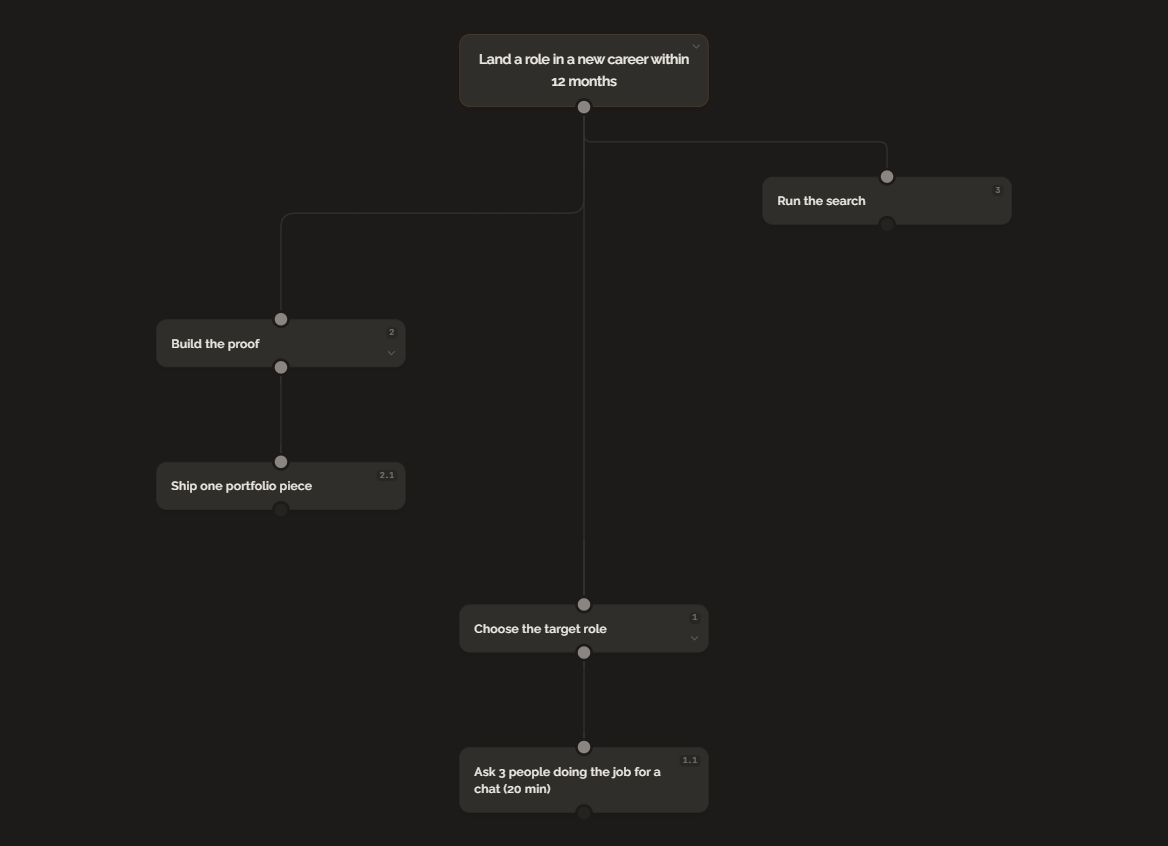
The tree has three branches, each with one concrete first step:
Choose the target role. The first step is not updating your resume. It is asking three people who already do the job for a 20-minute chat. That single conversation validates the target or redirects it before you invest months in the wrong direction.
Build the proof. Ship one portfolio piece that demonstrates you can do the work. For a product role, that might be a competitive teardown. For a design role, a redesign of a real product with documented user research. The point is to have something to show that is better than "I learn fast."
Run the search. Once the target is chosen and the proof exists, the search is a pipeline problem. Each application becomes a branch with its own sub-steps: tailor the materials, submit, prep for the screen, follow up. The search branch only activates after the first two branches produce results, which is the order most career changers get wrong.
The first action on the tree ("Ask 3 people doing the job for a chat (20 min)") is designed to fit into a single lunch break. That is the entire point of backward planning: you start at the offer and work backward until the next step is small enough to do today without quitting anything. If your career change plan does not start with a step that small, it is not broken down far enough yet. See your first step in 60 seconds by entering your target role into GoalBranch and letting it generate the full tree.
The Bottom Line
A career change does not require quitting blind or burning your savings. It requires a clear target, honest proof, and a backward timeline that surfaces dependencies before they become emergencies. The first step is one 20-minute conversation with someone who already has the job you want.
FAQ
How long does it take to plan a career change?
Most career changes take 6 to 18 months from first serious research to a signed offer, with the middle range clustering around 9 to 12 months. Backward planning helps by breaking that timeline into concrete milestones you can execute while still employed.
How do I plan a career change without quitting my job?
The backward method is designed around a dual track: keep your current income while you choose your target role, build proof through side projects, and run your search. You only quit when the offer is signed. The tree in this post shows exactly how the three tracks fit together.
What is the first step in planning a career change?
The first step is not updating your resume. It is choosing the right target role by talking to people who already do it. The backward plan in this example starts with: ask three people doing the job for a 20-minute chat to confirm the role is what you expect.
Can I change careers without going back to school?
Yes. Many career changes rely on transferable skills plus a portfolio piece rather than a new degree. The key is mapping what your target role actually requires against what you have already done, which backward planning surfaces naturally.
Ready to try backward planning on your own goals?
Start planning freeMore guides
How to Get Your First Freelance Client: Work Backward From the Invoice
Landing your first freelance client is a chicken-and-egg problem. Working backward from a clear invoice gives you a concrete path from zero to paid work.
How to Learn a Language: A Backward Plan From Conversation Day
Most language plans start with an app and hope for the best. Backward planning starts at the conversation you want to hold and works back to today. Here's how.