How Do You Turn a Vision Board Into a Plan?
A vision board shows what you want but not how to get it. Six steps turn any image on your board into a backward plan with a first step you can do today.
TL;DR: To turn a vision board into a plan, pick one image, restate it as a specific goal with a date, then work backward: ask what has to be true just before it, and keep asking until you reach a step you can do in one sitting. The board keeps the dream visible. The backward plan supplies the route. Do this for one image first.
A vision board is a good answer to the question "what do I want?" It is a poor answer to "what do I do on Monday?" The board gets made in an afternoon, hung on a wall, and then quietly stops changing anything, because nothing on it says what to do next.
The fix does not require a new board. It requires a plan attached to each image. This guide shows how to build that plan, step by step, using a kitchen as the example.
Why a Board Needs a Plan Attached
A board is a picture of the finish line. It cannot show what depends on what, what comes first, or how long anything takes. Those are the things a plan holds. For more on why boards stall without one, see why vision boards fail.
Backward planning is the method that fits a board best, because a board already starts at the end. You do not need to invent a destination. You only need to work out the chain between the destination and today. A 2017 study in Psychological Science (Park, Lu, and Hedgcock) found that people who planned backward completed more tasks and reported greater motivation, higher goal expectancy, and less time pressure than forward planners.
How to Turn a Vision Board Into a Plan in Six Steps
1. Choose one image. Pick the one that you would most regret never starting. Leave the rest of the board alone for now. Planning a whole board at once is how plans stay unfinished, and one complete plan teaches you the method faster than six half-built ones.
2. Restate the image as a specific goal. A picture of a beautiful kitchen is not yet a goal. "Renovate the kitchen for under $15,000 by next June" is. Put a date, a place, or a number into the sentence. Specific wording is what lets the next steps have real answers. If you already write your outcomes out as scenes, the same approach is covered in scripting vs backward planning.
3. Ask what has to be true just before it. Write the answer as a condition, not a to-do. For the kitchen: the plan is locked, the long-lead items are ordered, and the build is scheduled. These become the first branches under your goal.
4. Ask the same question of each branch. Take "the long-lead items are ordered" and ask what has to be true before that. You get "cabinets and countertops are ordered", which has a lead time of eight to ten weeks. That fact pushes the order date earlier than you might have guessed. Backward planning surfaces constraints like this because it starts from the deadline.
5. Stop at a step that fits in about twenty minutes. When a step is small enough to start in one sitting, it stops needing motivation. "Get three contractor quotes" is a short first action. "Renovate the kitchen" is not.
6. Attach the first step to the image. Put the step next to the picture, on the wall or in the app where the board lives. The image shows why. The step shows what. Together they are a plan you will actually see.
If you want the tree generated for you, turn your board image into a goal tree and see your first step in 60 seconds.
A Worked Example: The Kitchen Image
Here is the kitchen goal broken down backward:
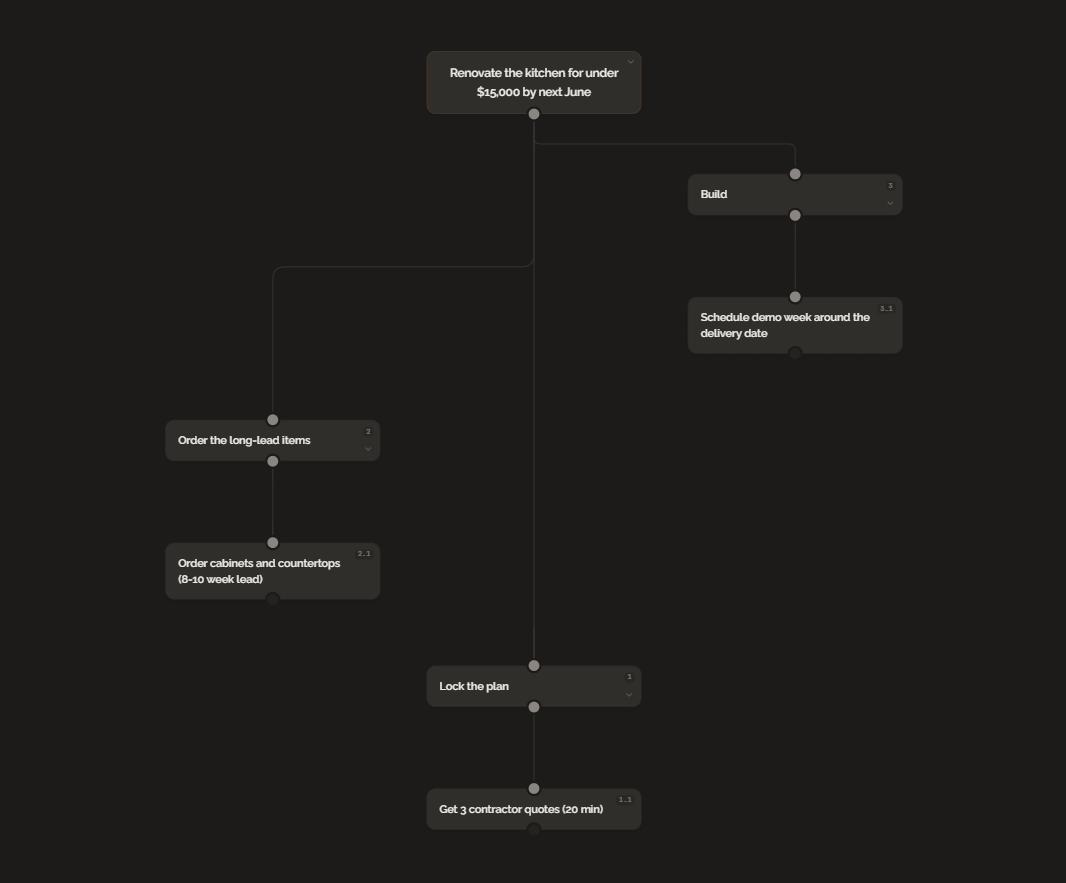
Three branches sit under the goal. "Lock the plan" has one first step under it: get three contractor quotes. "Order the long-lead items" notes that cabinets and countertops take eight to ten weeks to arrive. "Build" is scheduled around that delivery date, with demolition timed so the room is not empty while you wait.
Notice that the first step, getting three quotes, is not the first thing you would do if you started from today and thought forward. A forward plan tends to start with the fun part, such as choosing finishes. Working backward from the June deadline shows that quotes and orders come first, because they have the longest lead.
Keep the Board, Add the Tree
You do not have to choose between the two. The board is for staying connected to what you want, and the tree is for knowing what to do next. Many people keep a physical or digital board and attach a short plan to each image they are serious about. For templates that make the board itself easier to build, see the digital vision board template and best digital vision board tools.
If you scripted your goal instead of picking images, the scripting page covers the same bridge for written end states.
The Bottom Line
A vision board answers what you want. A backward plan answers what to do first. Choose one image, turn it into a goal with a date in it, and ask what has to be true just before it until you reach a twenty-minute step. Then do that step this week.
FAQ
How do you turn a vision board into a plan?
Choose one image, write it as a specific goal with a date, then ask what has to be true just before it. Repeat the question on each answer until you reach a step small enough to start in one sitting. That chain of conditions is the plan attached to the image.
Do you need to plan every image on your vision board?
No. Plan one image first. A board often holds more wishes than you can act on at once, and a single finished plan teaches you the method. Come back to the other images once the first one is moving.
What is the first step after making a vision board?
Pick the image that matters most and turn it into a goal with a place or a date in it. A picture of a kitchen becomes a goal about renovating a particular kitchen by a particular month. Only then can you ask what has to happen first.
How often should you revisit a vision board plan?
Look at the first step every time you open the board, and review the whole tree when something changes, such as a quote coming in higher than expected. Plans are meant to be edited as you learn, so a revision is a normal part of the process.
Ready to try backward planning on your own goals?
Start planning freeMore guides
Scripting vs Backward Planning: Write the Goal, Then Plan the Steps
Scripting writes your end state as if it already happened. Backward planning turns that end state into steps. Here is how the two fit together, with an example.
Vision Board With Goals: Attach a Step to Every Image
Most vision boards show dreams without the steps to reach them. Here is how to attach a backward plan to every image and turn your board into a real roadmap.