Digital Vision Board Template (Free): Structure Beats Collage
A vision board shows your dream. A digital vision board template with backward planning turns each image into a next step. Free template and example inside.
TL;DR: A vision board captures what you want. A digital vision board template adds the structure that turns each image into a real next step. This post covers a free three-column template you can copy today, a worked example using a career change vision board, and how to generate yours automatically if you prefer a guided version.
What a Digital Vision Board Does That Collage Can't
Collage-style vision boards clarify what you want. Cutting out pictures of a beach house, a passport, or a fit body forces you to name the dream. That is real value.
The problem comes the day after. The images hang on your wall or sit in a folder, and nothing has changed. The dream is clearer, but the path is not. That gap between desire and action is where most vision boards lose their power.
A digital vision board template solves this by pairing each aspiration with a structure. Instead of an image floating alone on a canvas, it sits next to a milestone and a first step. The board stays aspirational, but every aspiration now has a job to do.
This difference matters for follow-through. A 2017 study in Psychological Science (Park, Lu, and Hedgcock) found that people who planned backward completed more tasks and reported greater motivation, higher goal expectancy, and less time pressure than forward planners. A template built around backward planning gives your vision board the same structural advantage.
The roundups of best digital vision board tools cover excellent apps for the collage side. The template below covers the planning side.
The Digital Vision Board Template
Copy this structure into your tool of choice: a document, a spreadsheet, a whiteboard, or GoalBranch. Each row is one aspiration from your board.
| My Vision | What It Looks Like When Real | The 20-Minute First Step |
|---|---|---|
| A career I love | Landed a role in a new field within 12 months | Ask 3 people doing that job for a chat |
| Financial freedom | $10,000 emergency fund saved | Set an automatic monthly savings transfer |
| A healthier body | Can run 5K without stopping | Find a beginner plan and lace up your shoes |
| Time abroad | Work remotely from another country for 3 months | Research visa requirements for 3 target countries |
| A creative side project | Launched something to 100 users | Write the one-sentence offer for the project |
The three columns do different work.
My Vision is the dream language that makes the board personal. This is the image you would cut out of a magazine: a photograph of a beach, a screenshot of a job title, a picture of a fit body. Keep it aspirational. Every board needs a reason to look at it.
What It Looks Like When Real turns the dream into a measurable outcome. This is the hard step because it requires a number or a deadline. "A career I love" becomes "Landed a role in a new field within 12 months." "Financial freedom" becomes "$10,000 emergency fund saved." The number makes it real. Without a number, the image stays a wish.
The 20-Minute First Step gives you something to do before the motivation fades. This is the most important column. A vision board that leads to immediate action keeps its power. A vision board that does not becomes wallpaper. Each first step must take no more than 20 minutes. If it feels too big, break it down further. The step should be something you can start as soon as you finish reading this post.
Each row of the template is a complete backward plan in miniature: vision, milestone, first step. If you want a version that generates the milestones and steps for you automatically, generate yours in GoalBranch and see your first step in 60 seconds.
Real Example: A Career Change Vision Board
Career change is one of the most common things people put on vision boards. The dream is clear: leave the current role, find something that fits. The path is anything but. Without a plan, that vision board image of a new career title stays on the wall while the same routine repeats each week.
Here is how that dream looks as a backward-planning tree in GoalBranch:
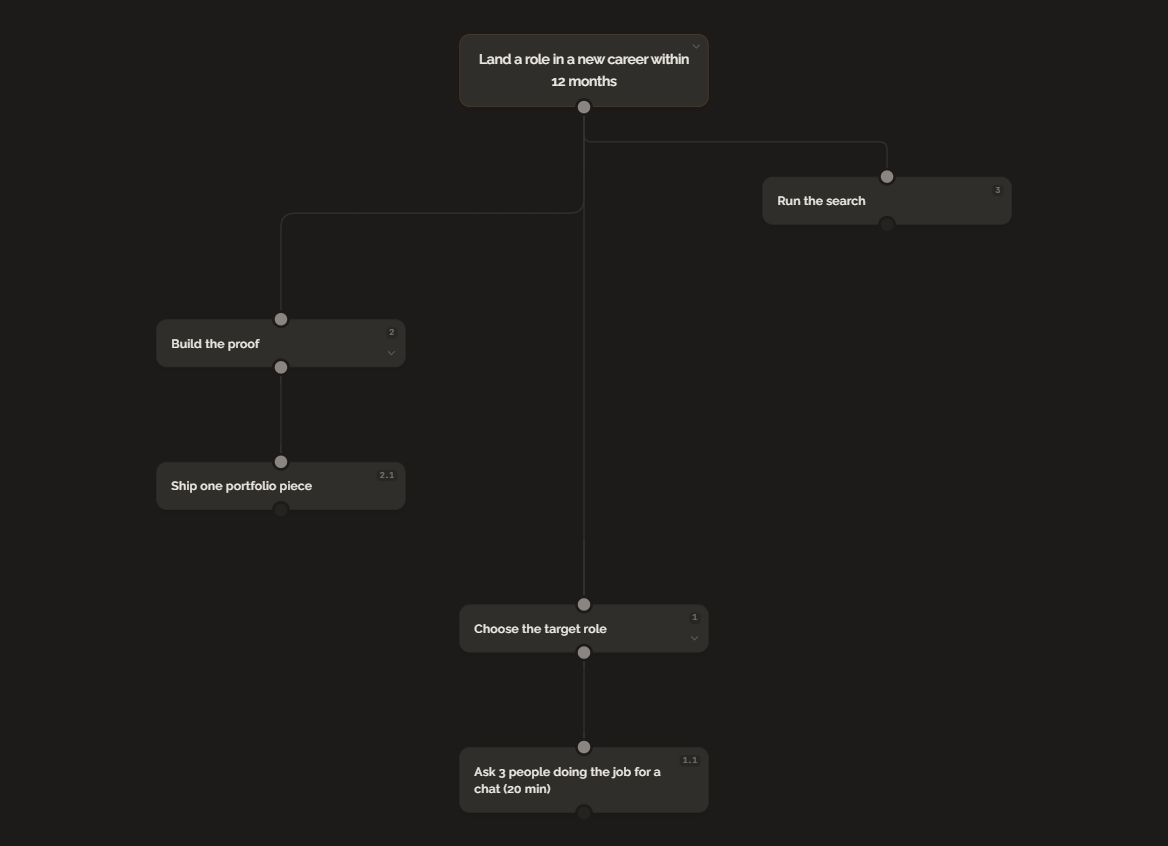
The tree breaks the career change vision into three milestones:
Choose the target role. You cannot land a role you have not named. Many career change boards fail because the image is vague: "business owner" or "tech job." This milestone forces precision. The first step is 20 minutes: ask three people who already do that job for a short chat.
Build the proof. Once you know the target, you need evidence you can do the work. Without proof, every application starts from zero. Ship one portfolio piece, write one case study, or complete one certification. One piece of proof is enough to open the first conversation.
Run the search. With a clear target and proof of ability, the search becomes a process instead of a wish. Update your materials, talk to your network, and apply to the roles that match. Each week has a target number of applications.
Each milestone has its own smaller steps, and the tree ends with a single first step that takes 20 minutes. That is the template in action: a vision board aspiration, broken into a plan. The same structure applies to every row in the template above. If you have a savings goal on your vision board, the same pattern applies: name the number, set the automatic transfer, track one week of spending.
How Most Vision Boards Stall
The reason vision boards get a reputation for not working: they show outcomes but skip the path. A picture of a fit body with no plan for the first workout becomes a guilt trigger. A beach house with no savings target stays a fantasy.
The difference between a powerful vision board and a frustrating one is not the quality of the images. It is whether each image has a path attached. The fix, covered in more detail in our post on why vision boards fail, is not to abandon the board. It is to attach a structure to every image.
How to Build Your Template
Start with three to five aspirations, one from each area of your life. For each one, name the vision in a short phrase, define what it looks like when real with a number or deadline, then identify the 20-minute first step. If you cannot think of a 20-minute step, the milestone is too large. Break it down until a small task appears. A step like "research programs" becomes "open the course catalog for three programs." The smaller version is the right one.
When you finish, looking at the board reminds you why you are doing this. Reading the first step column tells you what to do next. For the design side, our guide on how to make a digital vision board in Canva walks through creating the visuals. The template here gives you the plan that makes them real.
The Bottom Line
A digital vision board template with backward planning does what a collage alone cannot: it gives every dream a next step. Copy the template above, pick one aspiration that matters most, and do the 20-minute first step right now. The rest of the tree can wait until tomorrow.
FAQ
What is a digital vision board template?
A digital vision board template is a structured layout for collecting images that represent your goals, with space to attach action steps to each aspiration. Unlike a free-form collage, a template ensures that every dream on your board has a corresponding plan.
How do I make a digital vision board with action steps?
Start by listing your top three to five aspirations. For each one, define what it looks like when real and identify a single 20-minute first step that moves toward it. Use the template in this post as a starting point, or generate one automatically in GoalBranch.
What's the difference between a vision board and a goal plan?
A vision board shows what you want. A goal plan shows how you get there. A digital vision board template bridges both by placing each image next to a concrete milestone and a first step, so inspiration has a path forward.
What should I include in a vision board template?
The three essential columns are: your vision or aspiration, the milestone that confirms progress, and a single small first step you can take today. These three layers turn a passive collage into an active plan.
Ready to try backward planning on your own goals?
Start planning freeMore guides
Reverse Goal Branch Template (Free: Excel, PDF, and Auto-Generated)
A free reverse goal branch template you can copy in one minute, plus a real example that works a big goal backward until the first step takes 20 minutes.
Goal Setting Templates for Students (Free, With a Real Example)
Free goal setting templates for students: a backward planning worksheet, semester tracker, and weekly target sheet. Each includes a worked exam prep example.