Why Vision Boards Fail (and What to Do After You Make One)
Vision boards show the dream but don't produce the steps. Here is why they stall and how to turn your vision into a backward plan that actually moves.
TL;DR: Vision boards work for clarifying what you want, but they fail at producing the steps to get there. The problem is not the vision. It's the missing plan. The fix is to attach a backward plan to each image, turning every dream on your wall into a chain of real, doable steps. This post explains why boards stall and exactly what to do about it.
Why Vision Boards Stall
Vision boards work, but only halfway. They help you get clear on what you want, and that clarity is a genuine first step. Seeing your goals daily keeps them top of mind. The problem is not that visualization is useless. The problem is that a board shows the destination without showing the route.
The core failure is one of completeness. A vision board is a picture of the finish line. It doesn't tell you what comes first, what depends on what, or what to do this week. When the initial motivation fades (and it always does), there's no plan to fall back on. The board becomes wallpaper, and the goals stay stuck on the wall.
You spend an afternoon cutting out images, arranging them, and gluing them down. It feels productive. You've clarified what you want, and that has real value. But once the board is up, the real work is supposed to begin, and that's exactly where most people stop.
The image shows where you want to go. It doesn't show the path. That gap between desire and action is where vision boards fail. Not because the dream is wrong, but because the dream arrived without a plan.
Step 1: Recognize That Boards Show, They Don't Plan
A vision board is a collection of outcomes. A photo of a beach house. A picture of a van. A magazine cutout of someone who looks fit and healthy. Each image represents a result, not a route.
Ask yourself what your board actually tells you. Does it tell you what comes first? Does it tell you what depends on what? Does it tell you what to do this week?
It doesn't. And that's not a flaw in the board itself. It's a limitation of the format. A board is designed to display, not to sequence. It's a vision tool, not a planning tool.
That's where backward planning comes in. Backward planning starts at the outcome and works in reverse, identifying every dependency and milestone between the dream and today. Instead of guessing what to do next, you trace the path from the finish line back to the starting line.
A 2017 study in Psychological Science (Park, Lu, and Hedgcock) found that people who planned backward completed more tasks and reported greater motivation, higher goal expectancy, and less time pressure than forward planners.
Step 2: Turn Every Image Into a Backward Chain
Here's how to connect any image on your board to a real plan.
Pick one goal. Write it at the top of a page. Now ask: "What has to be true one step before this goal is real?" Write that down. Then ask again. Keep going until you reach something you can do this week.
The result is a chain of milestones that turns a vague dream into a sequence of specific, actionable steps.
Let's walk through a concrete example. Say a picture of a van is on your board: you want to live on the road. Working backward:
- Living on the road full-time: the van is bought and converted
- Before that: you have $15,000 saved for the van and the trip
- Before that: you know which van model fits your needs and budget
- Before that: you have a remote income stream that covers monthly costs
- Before that: you've researched what life on the road actually costs
Each item is a milestone. Each milestone can be broken into smaller sub-steps. The smallest step, the one you can do this week, might be "research cost of living for van life in 2 regions (20 minutes)."
That's not a vision anymore. That's a task.
Real Example: From Beach House Dream to Tree
The most reused example in our blog is the "Live 6 months a year by the sea" tree. It's a perfect test case for this method because it starts as a pure vision: sun, sand, waves, slow mornings. That's exactly the kind of image that ends up on a vision board.
Here's what the backward plan looks like as a GoalBranch tree:
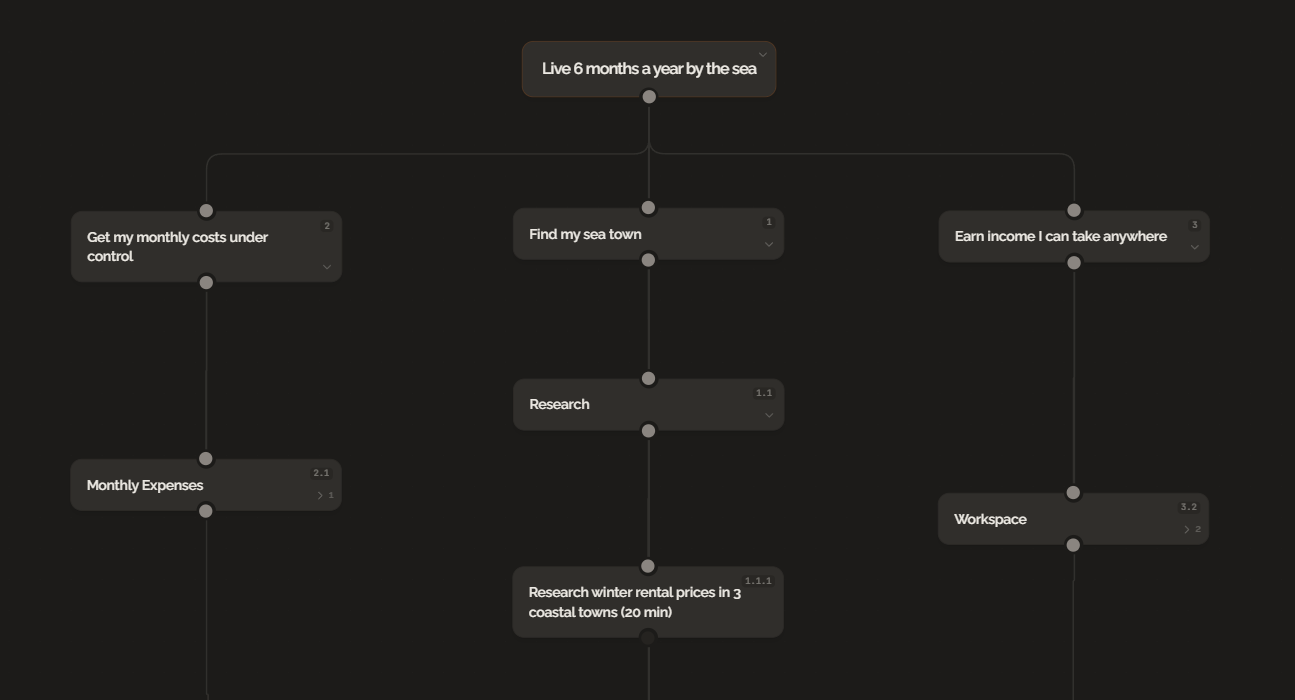
The root goal sits at the top. Three main milestones branch out beneath it: earn income that works from anywhere, find the right coastal town, and get monthly costs low enough to make the lifestyle sustainable. Each milestone has its own sub-steps. The "Find my sea town" branch, for example, breaks down into a list of candidate towns, a visit to each, cost of living comparisons, rental research, and a final pick.
The first step (research winter rental prices in three coastal towns) takes about 20 minutes. That is the actual distance between a vision board image and real action.
If you want to generate this kind of tree for any goal on your board, GoalBranch does it automatically: type your goal and see your first step in 60 seconds.
Step 3: Keep the Board, Add the Tree
The takeaway is not to throw away your vision board. The board has genuine value: it forces you to clarify what you want. That clarity is the hardest part of goal setting, and a well-made vision board delivers it better than most planning tools do.
The fix is to pair every image with a backward plan. One board, one tree per image. The image keeps the dream vivid. The tree makes it real.
This is the difference between a dream board and an action board. A dream board collects outcomes. An action board collects outcomes plus the steps to reach them. The plan is what turns one into the other. For more on this distinction, our best digital vision board tools roundup compares several approaches, including ones that add structure to the vision board format.
The Bottom Line
Your vision board isn't wrong. It's just incomplete. The dream matters, but without a plan it stays on the wall instead of becoming your life. Pick one image from your board, work backward from it until you find the step that fits this week, and take it.
FAQ
Do vision boards actually work?
They work for clarifying what you want and keeping your goals visible, but they don't produce the steps to reach them. A board shows the destination without mapping the route, which is why so many vision boards get made and then forgotten.
Why do vision boards fail?
Vision boards fail because they create motivation without a plan. The inspiration from making a board fades when there's no clear next step. Without a backward plan attached to each image, the board becomes background decor rather than a tool for action.
What should you do instead of a vision board?
Don't replace the board. Add a plan to it. Use backward planning to turn each image into a chain of real steps, starting from the goal and working backward to identify what needs to happen first.
How do you turn a vision board into a plan?
Pick one goal from your board. Write it at the top. Ask what has to happen just before it's real. Keep asking until you reach something you can do this week. That chain turns an image into a sequence of actionable steps.
Ready to try backward planning on your own goals?
Start planning freeMore guides
Vision Board With Goals: Attach a Step to Every Image
Most vision boards show dreams without the steps to reach them. Here is how to attach a backward plan to every image and turn your board into a real roadmap.
Backward Design vs Backward Planning: Same Idea, Different Rooms
Backward design and backward planning share one logic: start at the outcome and work back. One belongs to education, the other to goals. See how they compare.