How to Break a Big Goal Into Small Steps (Real Example)
Big goals feel impossible because they are too large to act on. Here is how backward planning breaks any goal into doable steps with a real worked example.
TL;DR: Breaking a big goal into small steps starts at the finish line, not at today. Work backward from your goal through milestones and branches until each step is small enough to do in one sitting. The goal gets smaller, but the steps stay real.
The most reliable way to break a big goal into small steps is backward planning: start at the outcome and work backward to today. Ask what has to happen right before the goal is reached, then what has to happen before that, until you reach something you can do in one sitting. A 2017 study in Psychological Science (Park, Lu, & Hedgcock) found that people who planned backward this way completed more tasks than people who planned forward. The method works because it converts a vague ambition into a chain of dependent steps where every task exists because the goal needs it.
The Five-Step Breakdown Method
Every big goal breaks down the same way, whether the goal is financial, creative, or personal. The layers are always the same: goal, milestones, branches, steps, and the first action. Here is how to walk through them.
Step 1: Name the Exact Outcome
Vague goals produce vague plans. "Get healthy" is a direction, not a goal. "Run a 10K in under 55 minutes by November" is a goal. You could show it to someone and they would know whether you hit it.
The test: Can you describe the goal with a number and a date? If not, keep sharpening until you can. The reverse goal setting template starts with this question for a reason: the rest of the breakdown only works if the anchor is solid.
Step 2: Map the Milestones Backward
With the outcome set, ask what must happen right before the goal is reached. That is your last milestone. Then ask what must happen before that. Keep going until you have a chain from done to today.
A milestone is not a task. It is a checkpoint that takes weeks or months. For a goal like "launch an online course," the milestones might be: course is live and has paying students, final module is recorded, curriculum outline is locked, topic is validated. Each milestone is a real achievement, not just "worked on it."
Step 3: Break Each Milestone Into Branches
Each milestone gets its own breakdown. Take one milestone and list every sub-goal required to reach it. Each sub-goal is a branch.
For the "course is live and has paying students" milestone, the branches might include: a sales page, an email list of potential students, a pricing decision, and a platform setup. Each branch is smaller than the milestone it belongs to. Each one is still too big to do today, but they are getting closer.
This is where backward planning separates from a standard to-do list. A to-do list collects everything that feels urgent. A backward plan contains only what the goal requires.
Step 4: Apply the Tuesday Test
Here is the filter that separates real steps from wishful ones. Can you do this step on a random Tuesday when you are tired and not feeling it?
- "Research business plans" fails the Tuesday test. It is vague and has no clear finish.
- "Spend 25 minutes reading three articles about lean startup methodology" passes. You know what to do, how long it takes, and when you are done.
A good step takes under 30 minutes, has a clear start and end, and fits in one sentence. If it takes a paragraph to explain, it is not a step. It is a milestone wearing a step costume.
Step 5: Find the First 20-Minute Step
Keep breaking branches down until one step takes about 20 minutes. That is your starting point. Everything else in the plan exists to support it.
"Set up a domain name for the course." "Write three email subject lines." "Message five people on LinkedIn to ask about their experience with this topic." These are the kinds of steps that pass the Tuesday test and get the goal moving.
Real Example: "Live Six Months a Year by the Sea"
Here is a real goal broken down through all five layers:
Goal: Live six months a year in a coastal town.
Three milestones working backward from the goal:
- Earn an income I can take anywhere (remote work or location-independent business)
- Find my sea town (pick a specific place)
- Get my monthly costs under control (save enough to cover the gap)
Branches under the "find my sea town" milestone:
- Research coastal towns that fit my budget and lifestyle
- Visit two candidates for a trial week each
- Compare winter rental prices and availability
- Make a decision by a target date
Steps under the "research coastal towns" branch:
- List climate, cost-of-living, and internet-speed criteria (30 min)
- Search for towns matching those criteria on nomad forums (20 min)
- Narrow to three candidates based on the research
The first step that passes the Tuesday test: Research winter rental prices in three coastal towns (20 minutes).
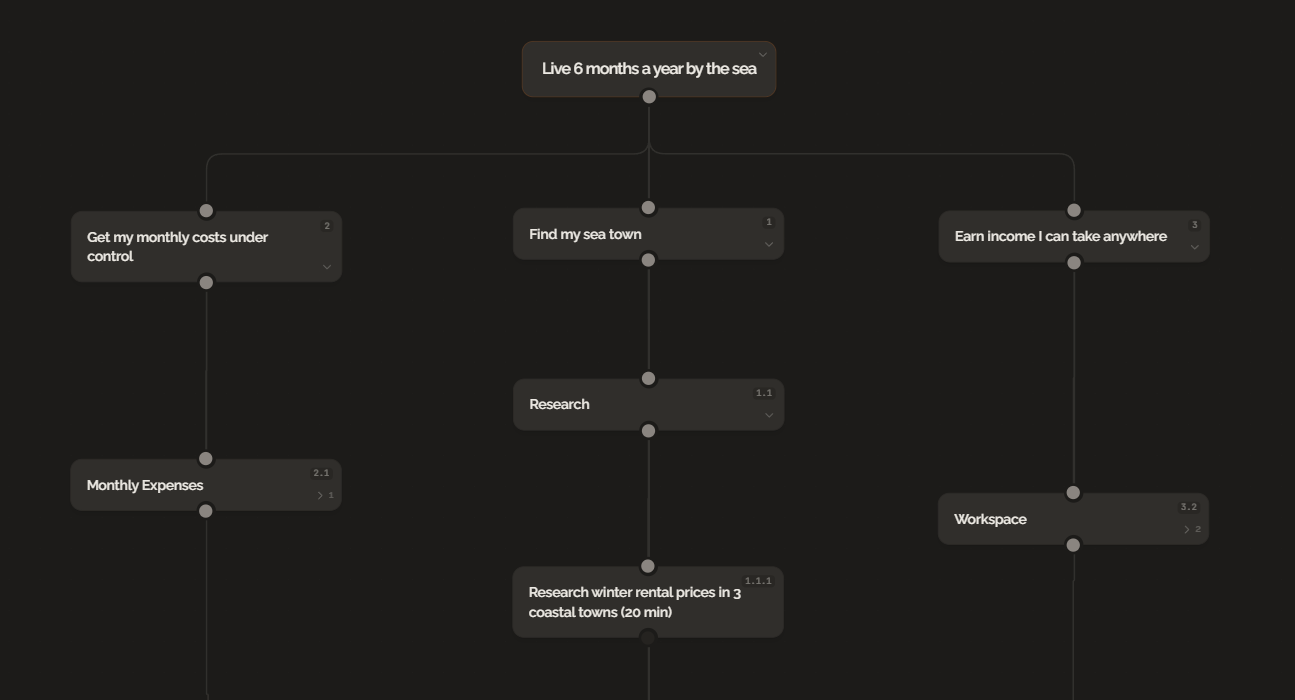
That first step is 20 minutes of browsing rental listings. It is not a warm-up exercise. It is a real piece of the goal, and the plan depends on it. Once you complete it, the next step is waiting in the tree, and each step is just as concrete.
You can build this tree yourself in any tool, or generate yours automatically in GoalBranch and see your first step in 60 seconds.
See how the size of the pieces changed. The goal is years out. The milestones are months apart. The branches take a weekend. The first step takes one evening. That is what the method does: it shrinks a dream down to something you can start tonight.
This same tree, with the same five layers, works for any goal. For more personal examples, see our backward planning for personal goals guide, which walks through the same process for fitness, savings, and habit goals.
The Bottom Line
A big goal is just a series of small steps you have not named yet. Start at the finish line, walk backward through milestones and branches, and stop when one step takes 20 minutes. That step is your starting point. The rest of the plan will be waiting for you when you get there.
FAQ
How small should a step be?
A step should take under 30 minutes, have a clear start and end, and fit in one sentence. If it takes a paragraph to explain, the step is still too big.
What is the difference between a milestone and a step?
A milestone is a major checkpoint that takes weeks or months to reach. A step is a single action you can complete in one sitting. A milestone contains many smaller steps working toward it.
Why does breaking a goal into small steps work?
Large goals stay vague because the jump from ambition to action is too wide. Small steps close that gap. Each completed step creates momentum, and the plan becomes a chain of actions you can trust.
What is the Tuesday test for goal steps?
The Tuesday test asks whether you could do the step on an ordinary Tuesday when you are tired and not feeling motivated. If the answer is no, the step is too big and needs to be broken down further.
Ready to try backward planning on your own goals?
Start planning freeMore guides
Vision Board With Goals: Attach a Step to Every Image
Most vision boards show dreams without the steps to reach them. Here is how to attach a backward plan to every image and turn your board into a real roadmap.
Backward Design vs Backward Planning: Same Idea, Different Rooms
Backward design and backward planning share one logic: start at the outcome and work back. One belongs to education, the other to goals. See how they compare.