How to Get Your First Freelance Client: Work Backward From the Invoice
Landing your first freelance client is a chicken-and-egg problem. Working backward from a clear invoice gives you a concrete path from zero to paid work.
TL;DR: Getting your first freelance client is a trust problem, not a skill problem. You need proof to get a client, but you need a client to get proof. Working backward from the invoice breaks this loop. Define the exact project, price, and deliverable first. Then work backward to identify the warm outreach, conversations, and proposal that get you to a signed deal. The tree below maps this as a 60-day plan.
The Chicken-and-Egg Problem
Every new freelancer hits the same wall. Clients want proof you can deliver before they hire you, but you need a client before you have proof. The standard advice is to build a portfolio, optimize your LinkedIn, and apply to 50 jobs on Upwork. That works eventually, but it takes months.
Backward planning offers a faster path. Instead of spraying broadly, you start at the finish line and work in reverse. For a freelancer, the finish line is an invoice: a paid project with a clear scope, timeline, and price. Once you have that target, everything else becomes a concrete question: what needs to be true before you can send that invoice?
The backward planning for founders guide shows this same method applied to product launches. The structure is identical: define the outcome, map backward, execute the first step. For freelancers, the outcome is a specific paid project.
Step 1: Define the One-Sentence Offer
Before you contact anyone, you need one service you can describe in a single sentence. Not "I do marketing" or "I help with websites." A sentence so narrow that the listener instantly pictures what you would do for them.
Weak: "I'm a freelance writer" Strong: "I write SEO blog posts for B2B SaaS companies, 1,500 words each, with keyword research included"
Weak: "I'm a web developer" Strong: "I build landing pages for early-stage startups using Next.js, delivered in one week"
Your offer needs a specific deliverable, a specific audience, and a specific timeline. This is not about limiting your future business. It is about making your first sale easy to understand, easy to refer, and easy to price.
Creators face a similar challenge when defining their first course or product. The backward planning for creators guide covers how narrowing the scope of a first launch makes the rest of the plan possible.
Step 2: Build the Pipeline Through Warm Outreach
The fastest path to a first client runs through people who already know you. Former colleagues, friends who run businesses, acquaintances from past jobs, people you have worked with in any capacity. They already know you are reliable. They just need to know you are available.
Write down 20 people who fit this description. Do not filter. Do not decide for them that they cannot afford you or do not need your service. Just list names. This list is your pipeline.
For each person, write a short, specific message. Reference your shared context. State what you are offering, who it is for, and what it costs. Keep it low-pressure: "I am working with a few early clients at a reduced rate. Would you be interested, or do you know someone who might be?"
Step 3: Start Conversations, Not Pitches
When someone responds, your goal is not to close the sale in the first message. Your goal is to understand their situation. Ask what they are struggling with, what they have tried, what a successful outcome would look like. Listen more than you talk.
After you understand their problem, propose one specific thing you can do. A single blog post. A single landing page. A single audit. The smaller the first project, the easier it is to say yes. Most early conversations will not turn into projects, and that is normal. The ones that do are worth more than the dozens that did not.
Step 4: Close With Written Terms
When a prospect wants to move forward, put everything in writing before you start working. The scope, the deliverables, the number of revisions, the timeline, the price, and the payment terms. This protects both of you.
Send an email or a simple document that says: "Here is what I will deliver. Here is when you will receive it. Here is what it costs. Here is when payment is due." Ask them to reply confirming. That reply is your agreement. It does not need to be a formal contract, but it needs to exist in writing.
Step 5: Deliver and Turn It Into Momentum
Deliver the project on time or early. Overdeliver on one small thing: an extra revision, a bonus tip, a helpful resource. Then immediately ask for a testimonial: "If you are happy with this, would you mind writing two sentences I can use on my website?"
Then ask for a referral: "Do you know anyone else who might benefit from this kind of work?" Most happy clients have never been asked directly. When asked, most are happy to help. One referral from a satisfied client is worth more than ten cold applications.
The Tree: Land Your First Freelance Client in 60 Days
Here is what the full backward plan looks like as a GoalBranch tree:
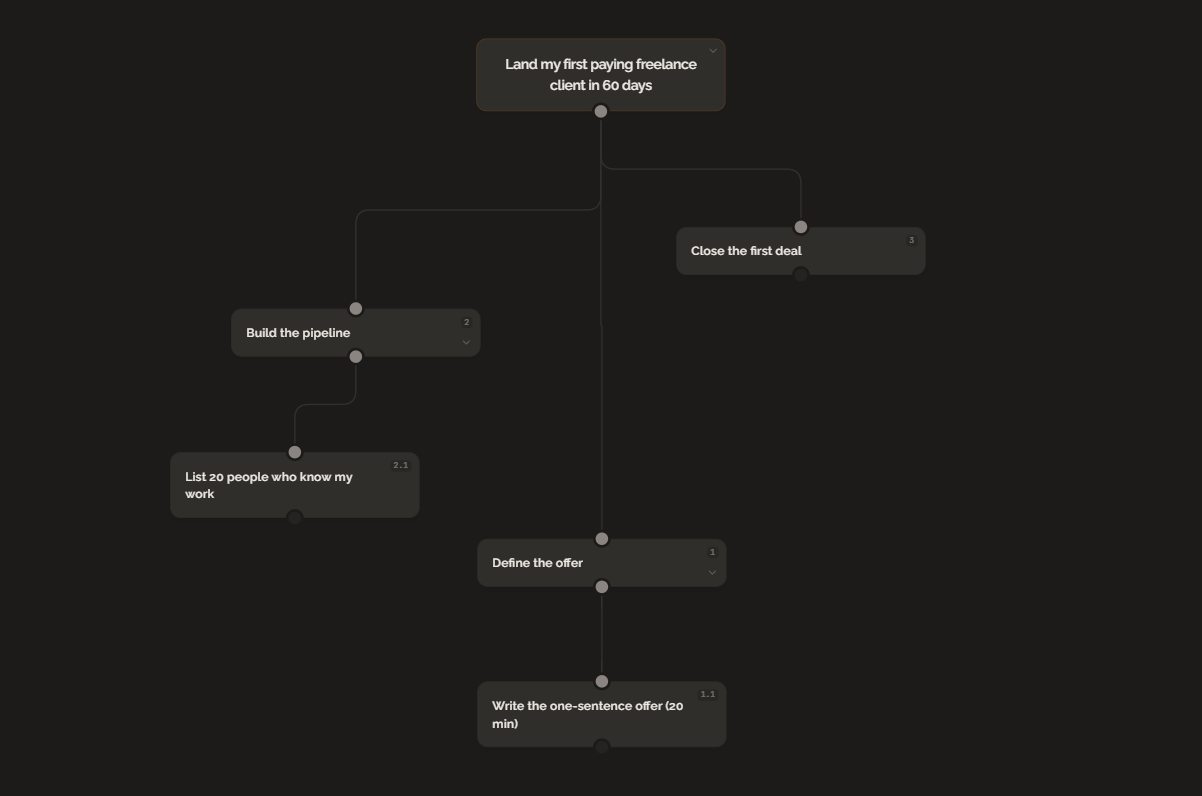
The tree starts with three main branches:
Define the offer. The root of everything. Until you can state what you do in one sentence, no outreach will land. The sub-step here is a single twenty-minute exercise: write the one-sentence offer. Do this before you do anything else.
Build the pipeline. The branch that most new freelancers skip entirely. List 20 people who already know your work. This one list is worth more than a year of cold applications. Each name is a warm lead that already trusts you more than any stranger on a platform.
Close the first deal. Once you have conversations happening, the close is about clarity: scope, timeline, price, and payment in writing. No ambiguity. No "we will figure it out as we go." The tree shows this as a single branch, but each conversation that reaches this stage will branch into its own sub-steps.
This tree is your plan from zero to your first paid project. You can generate yours automatically and see your first step in 60 seconds.
The Bottom Line
Every experienced freelancer started exactly where you are: zero clients, zero testimonials, zero proof. The difference between those who make it and those who stall is not talent or a better portfolio. It is the willingness to start from one specific offer, one warm message, and one small yes. Pick your one-sentence offer and write it down. That is your first step.
FAQ
How do I get my first freelance client with no experience?
Start with warm outreach to people who already know you: former colleagues, friends who own businesses, or acquaintances from past jobs. Offer one specific deliverable at a clear price. Your existing network reduces the trust gap that makes cold outreach so hard for beginners.
How long does it take to land the first freelance client?
It varies, but most freelancers who send consistent, personalized warm outreach land their first paid project faster than those who rely on sporadic cold applications. The biggest variable is outreach volume, not skill level.
How much should I charge my first freelance client?
Price a single, scoped deliverable at a fixed project rate rather than hourly. A clear, non-free price for a defined outcome signals confidence while keeping the barrier low enough for a first-time client to say yes.
Should I use Upwork or Fiverr to find my first client?
Those platforms work better once you have testimonials and past work to show. For your very first client, warm outreach to people you already know is faster because the trust barrier is already lower. Treat platforms as a secondary channel, not your primary strategy.
Ready to try backward planning on your own goals?
Start planning freeMore guides
How to Plan a Career Change Backward (Without Quitting Blind)
Backward planning for a career change starts with the target role, not the resume. Here is how to plan a career pivot step by step, with a real example tree.
How to Learn a Language: A Backward Plan From Conversation Day
Most language plans start with an app and hope for the best. Backward planning starts at the conversation you want to hold and works back to today. Here's how.