Goal Setting Templates for Students (Free, With a Real Example)
Free goal setting templates for students: a backward planning worksheet, semester tracker, and weekly target sheet. Each includes a worked exam prep example.
TL;DR: Most student goal setting worksheets ask you to fill in a goal and leave the rest up to you. These three templates are different: they use backward planning, so every step on the page exists because the goal needs it. Pick the template that matches your timeline (a semester, a term, or a single week), fill it in top to bottom, and stop when one step is under 20 minutes. The worked example uses a real exam goal so you can see what a finished template looks like.
Why Student Goals Need a Different Template
Most goal setting templates were designed for business or personal development. They assume you control your schedule, your budget, and your priorities. As a student, you do not. Your deadline is set by the exam board or the application cycle. Your dependencies include recommendation letters, registration windows, and syllabus coverage. A generic worksheet misses all of that.
The three templates below are built for student constraints. They all use backward planning, which is the same method covered in our backward planning for students guide: start at the finish line, ask what must be true just before it, and repeat until one step takes under 20 minutes.
Template 1: Semester Goal Plan
Use this for a full-term goal, such as a final exam, a certification deadline, or a major project due at the end of the semester.
+--------------------------------------------------------------------+
|                     SEMESTER GOAL PLAN                              |
+--------------------------------------------------------------------+
| GOAL (one sentence with number and deadline):                       |
|   Score 85+ on the June final exam                                  |
+--------------------------------------------------------------------+
| MILESTONES (what must be true before the goal):                     |
|   1. I know the exam format and marking scheme                      |
|   2. I have a study system that covers every topic                  |
|   3. I can score 85+ under timed conditions                         |
+--------------------------------------------------------------------+
| STEPS FOR MILESTONE 1 (Know the exam):                              |
|   - Get past papers and the mark scheme                             |
|   - Identify which topics carry the most marks                      |
|   - Note the question formats (essay, multiple choice, problem)     |
|                                                                     |
| STEPS FOR MILESTONE 2 (Study system):                               |
|   - Build a weekly revision timetable                               |
|   - Cover each topic once on the timetable                          |
|   - Mark weak topics for a second pass                              |
|                                                                     |
| STEPS FOR MILESTONE 3 (Practice under pressure):                    |
|   - Take a full past paper every two weeks                          |
|   - Review mistakes and re-study those topics                       |
|   - Simulate exam conditions (timer, no notes, no breaks)           |
+--------------------------------------------------------------------+
| FIRST STEP (20 minutes, doable today):                              |
|   Get past papers and the mark scheme from the exam portal          |
+--------------------------------------------------------------------+
Copy this template into a notebook or generate yours automatically. GoalBranch builds the tree for you, so you can expand any milestone into detailed steps without rewriting the whole page.
Template 2: Term Goal Worksheet
Use this for a shorter horizon, such as midterms, a certification module, or a project milestone. It is the same structure as Template 1 but collapses to a single page with space for two milestones instead of three.
+--------------------------------------------------------------------+
|                      TERM GOAL WORKSHEET                            |
+--------------------------------------------------------------------+
| GOAL:                                                               |
+--------------------------------------------------------------------+
| MILESTONE 1:                                                        |
|   Steps:                                                            |
|   -                                                                 |
|   -                                                                 |
+--------------------------------------------------------------------+
| MILESTONE 2:                                                        |
|   Steps:                                                            |
|   -                                                                 |
|   -                                                                 |
+--------------------------------------------------------------------+
| FIRST STEP (20 minutes):                                            |
+--------------------------------------------------------------------+
Short timelines need fewer milestones. A two-week study block for a midterm only needs two conditions: "I have reviewed all the content" and "I have practiced the question formats." The rest is detail.
Template 3: Weekly Study Target
Use this for a single week, linked to one of the milestones above. This is the template you actually look at each day.
+--------------------------------------------------------------------+
|                       WEEKLY STUDY TARGET                           |
+--------------------------------------------------------------------+
| THIS WEEK'S MILESTONE:                                              |
|   Know the exam format                                              |
|                                                              DONE?  |
| Monday:  Get past papers                             [  ]          |
| Tuesday: Map topics to mark scheme                  [  ]          |
| Wednesday: Note question formats                     [  ]          |
| Thursday: Review syllabus for gaps                   [  ]          |
| Friday:   Plan next week's study system              [  ]          |
+--------------------------------------------------------------------+
Weekly targets turn a semester plan into daily actions. They also surface slippage early: if Monday's step is still undone on Wednesday, the milestone is not on track.
Here is what the semester plan looks like as a GoalBranch tree:
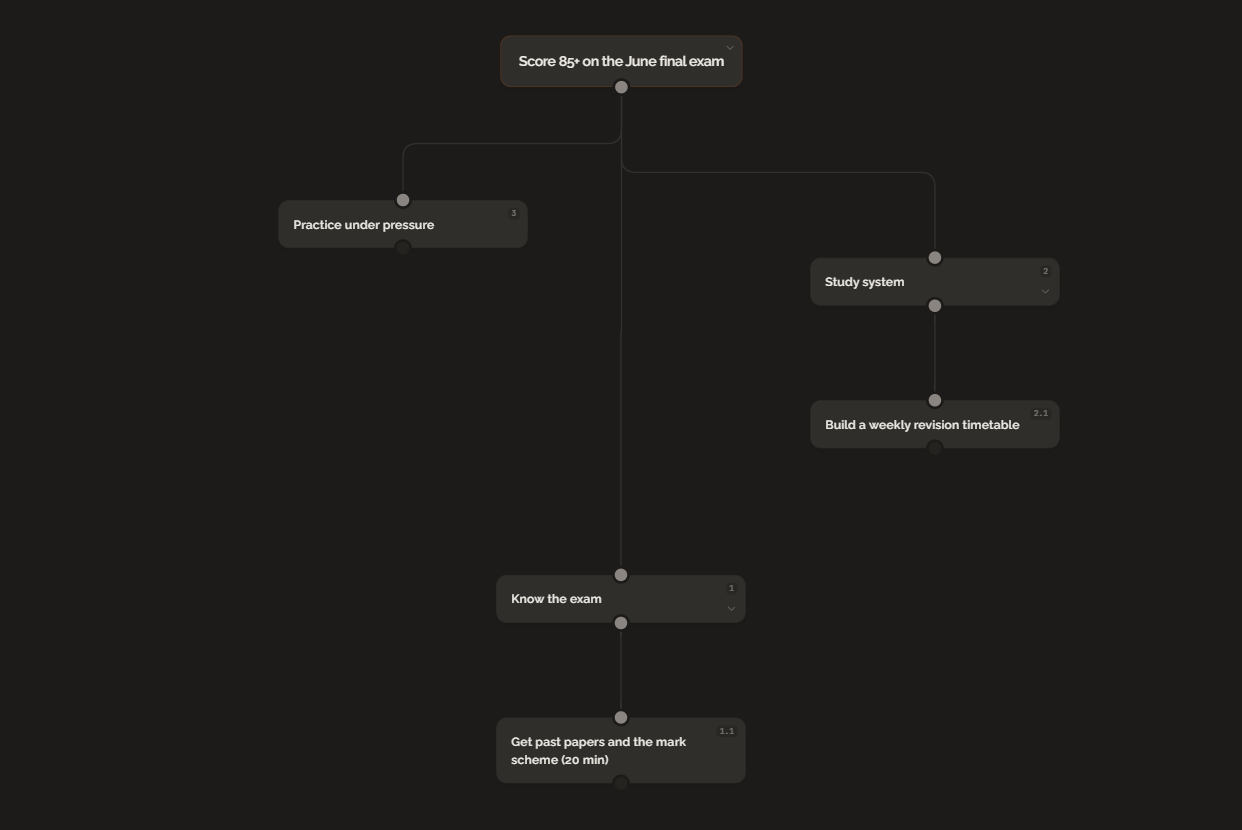
The first step is the same across every format: get past papers and the mark scheme. That is a 20-minute task anyone can do today, and it makes every later step more specific because you now know exactly what the exam asks.
How to Fill In Any of These Templates
The rule is the same for all three: fill them in top to bottom, never bottom to top.
Start with the goal. One sentence, one number, one deadline. "Do well on the exam" is too vague to produce specific steps. "Score 85+ on the June final exam" forces each milestone to be equally specific.
List the milestones. Each milestone answers the question "what must be true just before the goal is finished?" For an exam, you need to know the format, have a study system, and be able to perform under pressure. Those three conditions become the three milestones.
Break each milestone into steps. For "know the exam," the steps are the concrete actions that produce that knowledge: get the papers, map the topics, note the formats.
Stop at 20 minutes. The template is done when one step is small enough to do tonight. If the first step still feels large, break it down one more time.
For a more detailed walkthrough of the method behind these templates, see our backward goal setting worksheet, which explains the same four-layer structure with a printable format and additional examples.
The Bottom Line
Student goals are constrained by fixed deadlines, external dependencies, and competing subjects. Generic templates assume flexibility; these three assume reality. Pick the one that matches your timeline, fill it in from the top down, and stop when the first step is a 20-minute task you can start tonight. For the June exam example above, that step is getting past papers. For your goal, it will be something just as small.
FAQ
What is a goal setting template for students?
A goal setting template for students is a structured worksheet that guides you from a broad academic or personal goal down to specific, time-bound steps. Most templates use a top-down layout: the goal sits at the top, milestones in the middle, and the first small action at the bottom.
How do you set goals as a student?
Start by writing one specific goal with a deadline, such as "Score 85+ on my June final exam." Then list the milestones that must be true just before that goal. For each milestone, break it into steps small enough to do this week. Stop when one step takes under 20 minutes.
What is a good SMART goal for a student?
A good SMART goal for a student is specific enough to plan backward from. Instead of "do better in class," write "score 85+ on the June final exam through weekly practice tests starting this month." The concrete target lets you map the exact milestones and steps needed to reach it.
Why is goal setting important for students?
Without a structured goal setting process, students treat every subject equally and discover dependencies too late, such as needing recommendation letters months before an application deadline. A backward planning template surfaces those dependencies at the start.
Ready to try backward planning on your own goals?
Start planning freeMore guides
Reverse Goal Branch Template (Free: Excel, PDF, and Auto-Generated)
A free reverse goal branch template you can copy in one minute, plus a real example that works a big goal backward until the first step takes 20 minutes.
Digital Vision Board Template (Free): Structure Beats Collage
A vision board shows your dream. A digital vision board template with backward planning turns each image into a next step. Free template and example inside.