Vision Board vs Action Board: Which One Gets You Moving?
Vision boards show the dream. Action boards show the steps. Here is the real difference between them and how to combine both into a plan that actually moves.
TL;DR: A vision board shows the destination. An action board shows the route. The difference is a plan. Vision boards clarify what you want but stall when motivation fades. Action boards take each image and attach a backward chain of real steps. The best approach is both: keep the board for the dream and add a backward plan to make it real.
Vision boards have been around for decades. You cut out images, arrange them on a board, and look at them daily to keep your goals top of mind. They help with clarity and motivation. But they share a consistent weakness: a board shows where you want to go without showing how to get there.
An action board takes the same concept and adds one critical layer. Instead of just displaying the dream, it attaches a plan to every image. Each goal on an action board has a backward chain of milestones and steps that leads from the finish line back to something you can do this week. The vision stays, but the plan makes it real.
This distinction matters because the gap between wanting something and achieving it is not motivation. It is a plan. And the format of your planning tool determines whether you get one.
Vision Board vs Action Board: The Comparison
| What | Vision Board | Action Board |
|---|---|---|
| Purpose | Clarify and visualize your dreams | Visualize your dreams AND plan the steps |
| Output | A collage of images and quotes | A visual plan with images, milestones, and tasks |
| What it tells you | Where you want to go | Where you want to go, what comes first, and what depends on what |
| Time horizon | Long-term, open-ended | Short-term actions building toward long-term goals |
| After the initial rush | Motivation fades, board becomes decor | Each step leads to the next, momentum builds |
| Best for | Discovering what you want | Actually getting there |
The honest take: vision boards are not wrong. They are useful for the first step of goal setting, which is deciding what you actually want. The problem comes when you stop there. An action board does not replace the vision board. It completes it.
If you want to turn a vision board goal into an actionable tree in seconds, GoalBranch does it automatically: type your goal and see your first step in 60 seconds.
How to Turn Your Vision Board Into an Action Board
The shift from vision to action is simpler than most people expect. You do not need to throw away your board or start over. You just need to add a plan to each image.
Pick one goal from your board. Do not try to plan every image at once. The beach house, the van, the fit body, the successful business. Pick one and leave the rest for later.
Write the goal at the top of a page. Be specific. If the image is a van, write "buy and convert a van to live on the road full time." If it is a beach, write "live 6 months a year by the sea."
Work backward from the goal. Ask what has to be true just before that goal is real. Write it down. Then ask again. Keep going until you reach something you can do this week. This is the same method covered in our post on why vision boards fail, and the fix is always the same: attach a backward chain to the image.
The result is a chain of milestones that turns a vague picture into a sequence of real tasks.
Real Example: From Beach Image to Actionable Tree
The most common image on a vision board is a beach or coastal scene. It represents freedom, rest, and a slower pace. Here is what happens when you apply an action board approach to that image.
The backward chain for "Live 6 months a year by the sea" as an action board tree:
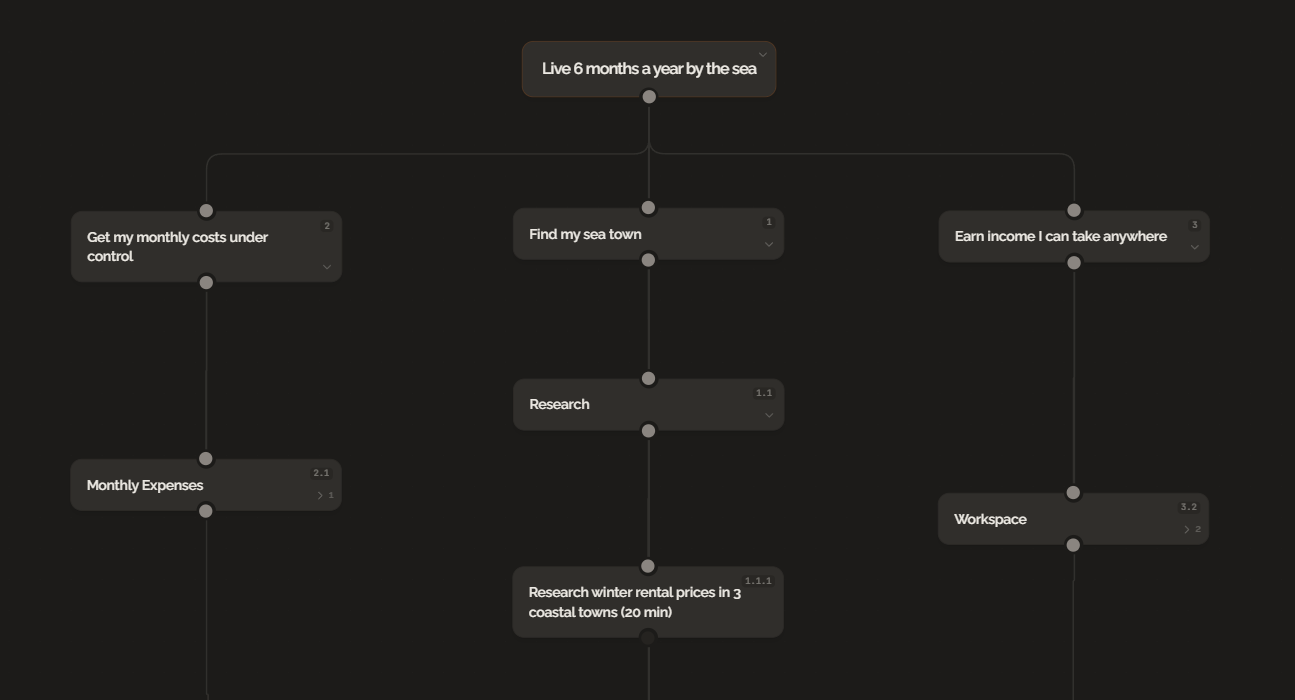
The root goal sits at the top. Three main milestone branches spread beneath: earn income that works from anywhere, find the right coastal town, and get monthly costs low enough to sustain the lifestyle. Each milestone has sub-steps. The "Find my sea town" branch, for example, breaks into a list of candidate towns, a visit to each, cost of living comparisons, and a final pick.
The first step in this tree is "Research winter rental prices in 3 coastal towns." It takes about 20 minutes. That is the distance between a vision board image and real action.
Why Action Boards Create Momentum
Vision boards create a burst of motivation. The act of making one feels productive because you are clarifying what matters. But motivation is a chemical state that fades. When it does, the board loses its power.
Action boards create momentum instead of motivation. Each completed step triggers a small sense of progress, which makes the next step easier. The plan itself generates forward motion, regardless of how motivated you feel on any given day.
A 2017 study in Psychological Science (Park, Lu, and Hedgcock) found that people who planned backward completed more tasks and reported greater motivation, higher goal expectancy, and less time pressure than forward planners. The study compared backward planning, which starts at the goal and works backward, with forward planning, which starts today and plans forward. An action board is backward planning applied to a vision board format.
Our best digital vision board tools roundup compares several approaches to making vision boards actionable, including tools that add structural planning to the format.
The Bottom Line
A vision board without a plan is decoration. An action board without a vision lacks direction. The answer is not to choose one over the other. Keep the board for the dream. Add a backward plan to make it real. Pick one image from your board today, work backward from it, and take the step you find.
FAQ
What is the difference between a vision board and an action board?
A vision board is a collage of images and quotes representing your dreams and goals. An action board takes those same images and attaches a specific plan to each one, turning every dream into a chain of actionable steps that lead there.
Does an action board replace a vision board?
No. An action board adds to a vision board, it does not replace it. The vision keeps your dream vivid and motivating. The action board makes it real by adding a backward plan to every image.
How do I make an action board?
Start with a vision board. Pick one goal from it. Write that goal at the top. Work backward and ask what has to be true just before that goal is real. Keep asking until you reach something you can do this week. That chain turns the image into a real plan.
Can a vision board actually help you reach your goals?
A vision board helps you clarify what you want and keeps your goals visible, which is valuable. But it does not produce the steps to get there. A board shows the finish line without mapping the route, which is why so many get made and then forgotten.
Ready to try backward planning on your own goals?
Start planning freeMore guides
Best Goal Planning Apps in 2026 (Free and Paid)
From free habit trackers to AI goal planners, here are the best goal planning apps in 2026 compared by features, pricing, and what they help you do in detail.
Digital Vision Board vs Paper: Which One Sticks?
Digital boards are convenient. Paper boards feel real. Neither turns a vision into a plan. An honest comparison and the fix to make either format work.