Best Goal Planning Apps in 2026 (Free and Paid)
From free habit trackers to AI goal planners, here are the best goal planning apps in 2026 compared by features, pricing, and what they help you do in detail.
TL;DR: Goal planning apps range from free habit trackers to AI engines that generate a dependency tree from a single sentence. TickTick and Todoist offer the strongest free tiers for task-driven plans. Habitica turns goals into a game. GoalBranch generates a full backward plan from any goal. The right app depends on whether you already know the steps or need help discovering them.
What Makes a Goal Planning App Worth Using
The best goal planning app is the one you actually open. Beyond that, a good app helps you do three things: define the outcome, break it into steps, and track progress. Some apps do all three. Most do one or two well.
Here is how six popular apps compare for goal planning. For AI-focused planning tools, see our AI goal planners roundup. For tools specifically for building a goal tree, see the goal tree tools comparison.
GoalBranch
Best for: Backward planning from a single goal sentence
GoalBranch is built around backward planning from day one. You type a goal like "Launch a side project to $1,000/month in 6 months" and it generates a complete dependency tree with milestones, branches, and single-sitting actions. Each node expands into sub-steps up to six levels deep. An infinite canvas lets you pan, zoom, and rearrange.
Key features: AI generates the tree from one sentence. Regenerate any branch independently with custom feedback. Progress tracking with completion percentage. Free for 1 goal tree and 25 tree actions per month. Pro at $9/mo for 30 goals and 500 actions. No credit card required for the free tier.
TickTick
Best for: All-in-one tasks, habits, and goals
TickTick combines to-do lists, habit tracking, a Pomodoro timer, and a calendar in one app. It added AI task suggestions in 2025. The free tier is generous: you can manage tasks, set habits, and track progress without paying.
Limitations for goal planning: TickTick is task-focused. You can organize tasks under projects and tag them by goal, but the app does not help you discover what those tasks should be. The AI suggests scheduling, not goal decomposition. You bring your own structure. Free tier available, Premium at $2.80/mo.
Todoist
Best for: Simple, clean task management with goal tracking
Todoist is the reference to-do app with a strong free tier and cross-platform sync. You can organize tasks into projects, set priorities, and track recurring habits. The Karma system adds streaks and levels as motivation.
Limitations for goal planning: Same structural gap as TickTick: it organizes tasks, not goals. Todoist has no native concept of backward planning or dependency trees. You can build a goal-tracking system using projects, labels, and filters, but you design it yourself. Free tier plus paid plans.
Habitica
Best for: Gamified habit building and goal tracking
Habitica turns tasks and goals into a role-playing game. Complete tasks to earn gold and experience. Miss habits to take damage. Join parties to fight monsters together. The gamification works for people who find standard to-do lists boring.
Limitations for goal planning: Habitica is strongest for daily habits and recurring tasks, not multi-month goal decomposition. You can track a long-term goal as a habit or daily, but the app does not help you break it into a dependency tree. Free to use. Optional subscription for in-game items.
Notion
Best for: Custom goal-tracking systems in a flexible workspace
Notion's databases, templates, and views let you build a goal-tracking system from scratch. You can create a goal database, link it to milestones and tasks, and view progress in table, board, or calendar layout. Notion AI adds text-based plan generation.
Limitations for goal planning: Notion does not backward-plan. You build the system yourself. The AI generates outlines, not dependency trees. There is no infinite canvas or visual tree. Free tier available. Notion AI at $10/mo. For a deeper comparison, see GoalBranch vs Notion.
Comparison Table
| App | Best For | Backward Planning | Free Tier | Paid Price |
|---|---|---|---|---|
| GoalBranch | AI backward planning | Native, automatic | 1 goal, 25 actions | $9/mo |
| TickTick | Tasks + habits + calendar | No | Strong free tier | $2.80/mo |
| Todoist | Clean task management | No | Strong free tier | Paid plans |
| Habitica | Gamified habits | No | Full free tier | Optional sub |
| Notion | Custom workspace systems | No | Limited free | $10/mo AI |
See your first step in 60 seconds. Generate your goal tree and start with the only app that backward-plans from a single sentence.
A Goal Planning App in Action
Here is what a backward-planned goal tree looks like in GoalBranch.
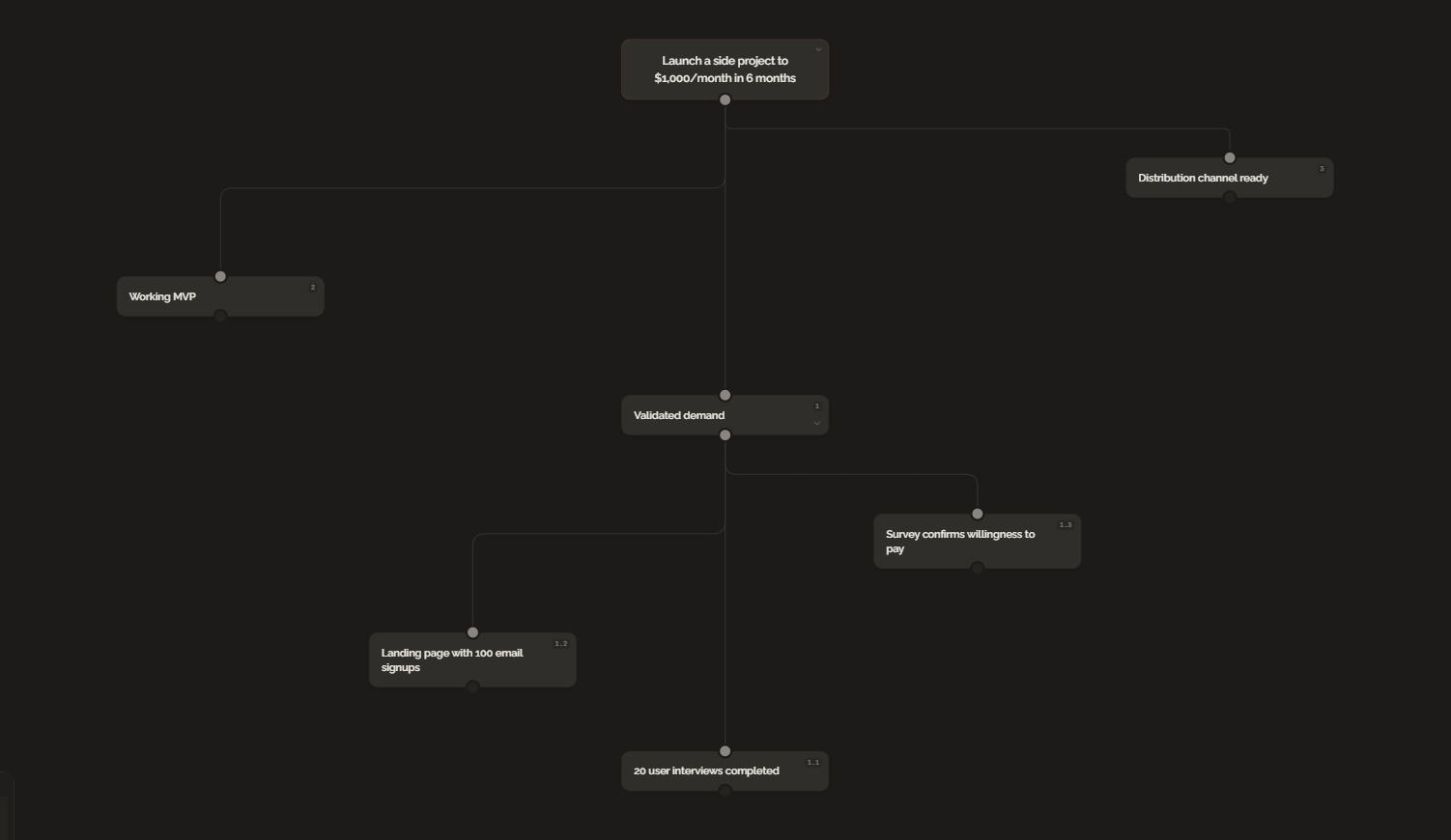
Goal: Launch a side project to $1,000/month in 6 months.
Milestones working backward:
- Validated demand (20 user interviews, 100 email signups, willingness-to-pay survey)
- Working MVP
- Distribution channel ready
The first action under validated demand is a 20-minute research session. That is the first step. Every branch is generated from the goal and can be expanded or regenerated independently. For more examples of real goals planned backward, see backward planning examples.
Which One Should You Choose?
Choose GoalBranch if: You have an ambitious goal and need help discovering the steps. GoalBranch generates the tree from one sentence, and you review, expand, and customize from there. No other app on this list does that.
Choose TickTick or Todoist if: You already know the steps and need a clean system to track progress day to day. Both have strong free tiers.
Choose Habitica if: You respond to gamification and want to build habits alongside your goals. The community and quest system add accountability.
Choose Notion if: You want to design your own goal-tracking system inside a broader workspace and need AI assistance for writing plans, not generating trees.
The Bottom Line
Goal planning apps solve different problems. Task managers keep you on track when you know the path. Goal planners like GoalBranch help you find the path in the first place by working backward from the outcome. Start with a free tier, whether that is TickTick, Habitica, or GoalBranch, and see whether you needed a system for execution or a system for discovery.
FAQ
What is the best free goal planning app?
It depends on your goal type. TickTick and Todoist have the strongest free tiers for task-driven goals. Habitica is fully free and gamified. GoalBranch offers 3 free goal trees with full AI backward planning. For a purely free option with no limits, Habitica is hard to beat.
What is the difference between a goal setting app and a task manager?
A task manager helps you organize and complete work you already know about. A goal planning app helps you figure out what the work is in the first place by breaking an ambition into steps, milestones, and dependencies.
Are goal planning apps worth it?
For a one-off goal like planning a trip or saving for a purchase, a free tier or a notebook is enough. For recurring goals or ambitious multi-month plans, a dedicated app saves time by structuring the breakdown and surfacing dependencies that manual planning misses.
Can I use Notion as a goal planning app?
Yes, with manual setup. Notion's database and template system can track goals, milestones, and tasks. What it does not do is generate a dependency tree or backward-plan from a goal sentence. You build the structure yourself.
Ready to try backward planning on your own goals?
Start planning freeMore guides
Digital Vision Board vs Paper: Which One Sticks?
Digital boards are convenient. Paper boards feel real. Neither turns a vision into a plan. An honest comparison and the fix to make either format work.
5 Tools for Building a Goal Tree (From Whiteboard to App)
A goal tree turns your ambition into a dependency map. Compare five tools for building one, from a whiteboard to apps that generate the tree automatically.