How to Plan a Goal When You Don't Know the Steps
You don't need to see the whole path to start a goal. Backward planning turns unknown steps into research questions and gives you a way forward starting today.
TL;DR: When a goal feels impossible to plan, the problem is not you. It is that forward planning needs a clear path and you do not have one yet. Backward planning works in the dark: start at the outcome you want, ask what must be true just before it, and work backward until you reach a step small enough to take today. Every blank spot becomes a question to research, not a reason to stop.
When you do not know the steps, most planning methods break because they assume you can see the path forward. Backward planning does not need the whole path. It only needs one thing: the outcome you want. From there, you work backward one level at a time, asking what must be true just before each milestone. Unknowns do not stall the plan; they become research questions. This turns an unplannable goal into a dependency tree where every gap is a question you can answer.
Start at the Finish Line
The most common advice is "break it into smaller steps." That works when you know what the steps are. When you do not, it just turns one blank page into several.
Backward planning flips this. Instead of starting at today, you start at the outcome and ask what had to happen just before it. When you do not know the full path, forward planning stalls because you cannot see past the first turn. Backward planning surfaces what you still need to learn before you can take the next turn. This is covered in our backward vs. forward planning comparison.
If you feel overwhelmed before starting, the overwhelmed by your goals post covers the same method through the lens of anxiety around big goals.
How to Plan When the Path Is Unclear
Step 1: Define the Best Guess Outcome
Write down the outcome even if you are not sure it is the right one. You will revise it as you learn, but a specific guess beats a blank page.
"Run a marathon" is too vague. "Finish a marathon in under 5 hours by next October" is specific enough to backward-plan from. If you cannot pick a number, pick a direction. "Move toward more creative work" gives you a filter for decisions without requiring a fixed endpoint.
Step 2: Work Backward One Level
Ask: what must be true right before I reach this outcome? Write down 2 to 4 things. Do not overthink it. Just list the conditions you would need to have in place.
For a marathon: a completed training plan, proper gear, and a registered spot in the race. Each of those can be backward-planned further.
For a career change: a clear target role, relevant skills or credentials, and a network in the new field. Some of these you can define immediately; others will be incomplete.
Step 3: Mark the Unknowns
Some items on your list will be blank. You do not know what it takes, who to talk to, or whether a step is even necessary. Mark these clearly. They are not failures in your plan. They are research questions.
This is where backward planning differs from a to-do list. A to-do list assumes you know the tasks. A backward plan exposes the gaps and tells you what to learn next.
Step 4: Let the Tree Ask You the Questions
Once you have one or two levels of milestones, look at the empty branches. Each one is a question directed at you: "What would it take to build the skills this role requires?" "Who do you need to talk to next?" "What does a portfolio piece in this field actually look like?"
This is where most people stall. Pick one unknown and make it a one-week research project. The tree will keep asking you questions as you fill in answers.
Start planning with GoalBranch and see your first step in 60 seconds, even when you do not know the full path. Generate your first tree
Step 5: Take the Smallest First Step
Your first step should not try to solve the whole goal. It should teach you something. The smallest step that produces new information is the right one.
For a career change: ask 3 people in the role for a 15-minute chat about what it involves. That is 20 minutes of work and it tells you more than a month of online research.
For a side project: ship one small thing to one person. The feedback tells you whether you are building something people want. AI tools like ChatGPT can help surface initial directions once you have a specific outcome in mind.
Real Example: Planning a Career Change Backward
A career change is the classic "I want this but I do not know how to get there" goal. The tree below shows three milestones, each one a question you answer by researching instead of guessing.
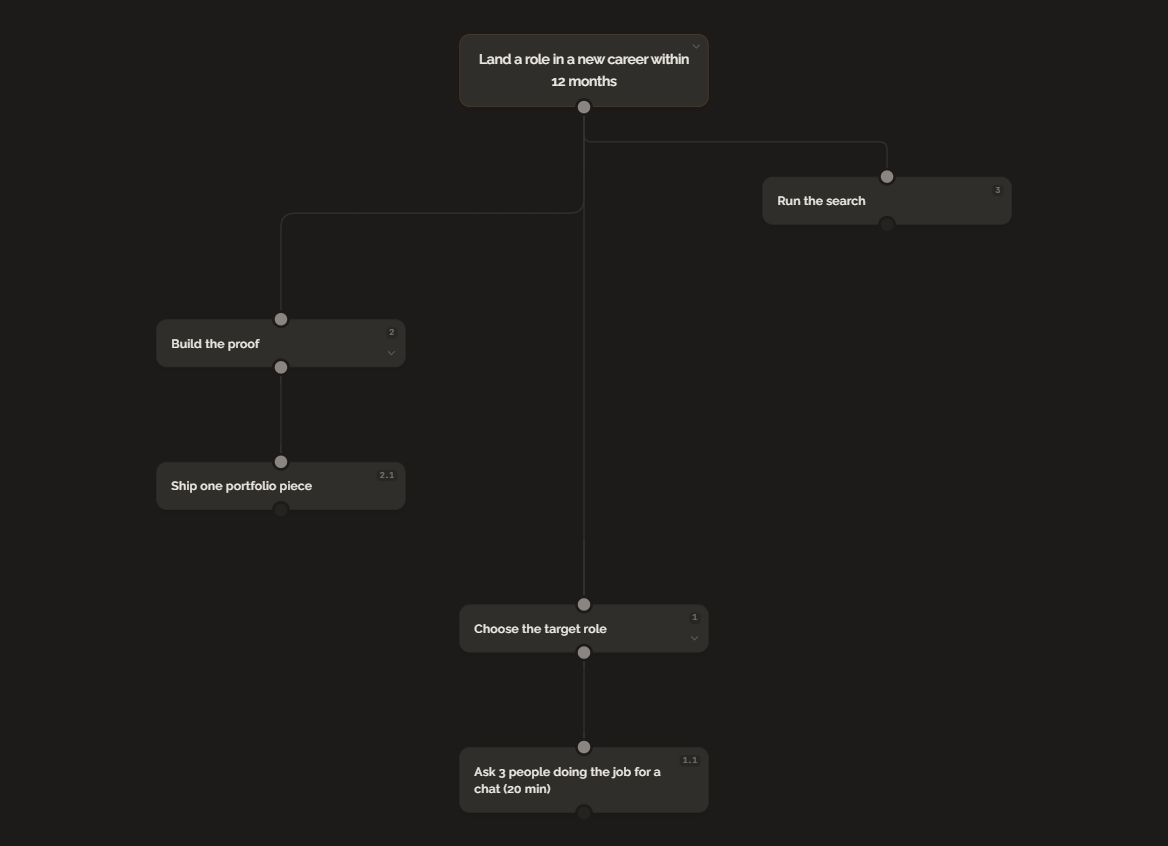
Working backward from "Land a role in a new career within 12 months":
- Choose the target role. You do not need to know the exact title yet. Research 3 roles where your existing skills overlap with the requirements. Talk to people in each one. The goal of this phase is narrowing, not committing.
- Build the proof. A resume alone will not open doors in a new field. You need one portfolio piece, one case study, one project that shows you can do the work. This phase surfaces questions about what counts as proof in that field.
- Run the search. Tailored applications, networking conversations, practice interviews. Each of these opens into smaller sub-steps as you learn what the process looks like.
Each branch opens into smaller questions. "What does a good portfolio piece look like in this field?" "Which companies hire career changers?" The backward plan does not answer these. It surfaces them so you know what to research next.
The first step is 20 minutes: ask 3 people who do the job for a chat about what the role involves. Do that today and the next step becomes clearer.
The Bottom Line
You do not need to see the whole staircase to take the first step. Backward planning works because it replaces "figure out the whole path" with one smaller question at a time. Start at the outcome, work backward, mark what you do not know, and research the biggest unknown first. The path reveals itself as you walk it.
FAQ
How do you plan a goal when you don't know the steps?
Start at the outcome and work backward one level at a time. Ask what must be true just before each milestone and answer with the next layer of steps. Repeat until you reach something small enough to do today. Unknowns become research questions instead of reasons to stall.
What if I don't even know what outcome I want?
Define a directional goal instead of a fixed destination. Instead of 'become a senior designer by 2027,' try 'move toward more creative work.' A direction gives you a filter for decisions without requiring certainty about the endpoint.
How is backward planning different from a regular to-do list for an uncertain goal?
A to-do list starts from today and assumes you know what needs doing. Backward planning starts from the outcome and exposes what you still need to learn, turning uncertainty into a structured discovery process instead of a blank page.
What is the first step when you have no idea where to start?
The best first step for an uncertain goal is one that teaches you something. Research what you need to know, talk to someone who has done it, or run a small experiment. The goal is not progress toward the finish line yet, it is progress toward clarity.
Ready to try backward planning on your own goals?
Start planning freeMore guides
Vision Board With Goals: Attach a Step to Every Image
Most vision boards show dreams without the steps to reach them. Here is how to attach a backward plan to every image and turn your board into a real roadmap.
Backward Design vs Backward Planning: Same Idea, Different Rooms
Backward design and backward planning share one logic: start at the outcome and work back. One belongs to education, the other to goals. See how they compare.