Overwhelmed by Your Goals? A 3-Step Way to Shrink Them
Overwhelmed by your goals? It is not a motivation problem. It is a planning problem. Here is a three-step method to shrink any goal down to one doable step.
TL;DR: Being overwhelmed by your goals is not a sign that you lack motivation. It is a sign that you lack a structure. Without one, every possible next step feels equally urgent and equally impossible. The fix is a three-step backward plan: pick the one goal that matters, work backward to find the single step you can do in 20 minutes, and ignore everything else until that step is done.
Overwhelm Is a Planning Problem, Not a Motivation Problem
When you feel overwhelmed by a goal, your brain is doing exactly what it evolved to do. It is scanning every possible path forward and finding too many of them open. Each option comes with uncertainty, each branch suggests more work than you have time for, and the result is not procrastination from laziness but paralysis from overload.
A 2017 study in Psychological Science (Park, Lu, and Hedgcock) found that people who planned backward completed more tasks and reported greater motivation, higher goal expectancy, and less time pressure than forward planners. That last finding about time pressure is the relevant one here. Forward planners feel the clock running because they are adding tasks to an ever-growing list. Backward planners feel the clock working for them because they are subtracting tasks until only the essential ones remain.
The method itself is not new. It comes from an old book on strategic thinking, and it has been used in aerospace engineering, project management, and military planning for decades. But the three-step version below is designed for the specific problem of overwhelm: not how to plan a complex project but how to shrink a goal that feels too big to a single step you can take right now.
Step 1: Pick the One Goal
Overwhelm nearly always comes from having too many goals at once. You want to get fit, save money, change careers, learn a language, and build a side project. Each one is reasonable on its own. Together they form an impossible stack.
Pick one. The one that matters most right now. Not the one that feels easiest or the one you have been avoiding longest. The one that, if you made progress on it this month, would make everything else feel easier.
This is harder than it sounds because choosing feels like abandoning the others. It is not. Backward planning shrinks goals by removing the noise of competing priorities. You are allowed to switch when this one is done. But for this plan, there is only one goal.
Step 2: Work Backward to a 20-Minute Step
Take your one goal and ask what must be true immediately before you reach it. Write that down. Then ask what must be true before that. Keep going until the answer is something you can do in 20 minutes.
The reason 20 minutes matters is that a step that small bypasses the overwhelm reflex. Your brain does not have time to argue with a 20-minute task. It can see the end of it. It can fit it into a Tuesday evening. A 20-minute step is not intimidating. It is just the next thing.
For example, if your goal is "land a new role in a different career within 12 months," working backward might look like this: signed offer letter, successful interviews, applications sent, target role chosen. Before you can choose the target role, you need to know what roles exist and what they actually involve. That is a research step. The 20-minute version? Ask three people who already do the job to chat about their day-to-day. You can send those emails in 20 minutes.
The structure that emerges from this process is a dependency tree. Each step exists because the step above it depends on it. There is no wasted work. This is the same structure our how to break a big goal into small steps guide builds step by step.
Step 3: Ignore Everything Else Until This Step Is Done
This is where backward planning beats traditional to-do lists. A to-do list shows you everything you could do. A backward plan shows you the one thing you must do next.
Until that 20-minute step is done, nothing else in the plan exists. Do not look at the second milestone. Do not research tools for step four. Do not open a notebook and start a separate plan for your savings goal. The only thing that matters is completing that first step.
Once it is done, the next 20-minute step reveals itself because the plan was built backward. You are not deciding what to do next each time. You are just following the chain.
This is how a goal that felt overwhelming becomes a sequence of small, non-negotiable tasks. Each one clears the way for the next.
See your first step in 60 seconds. Start a goal tree and type in your goal, and GoalBranch will generate the backward plan for you.
Real Example: Career Change in 12 Months
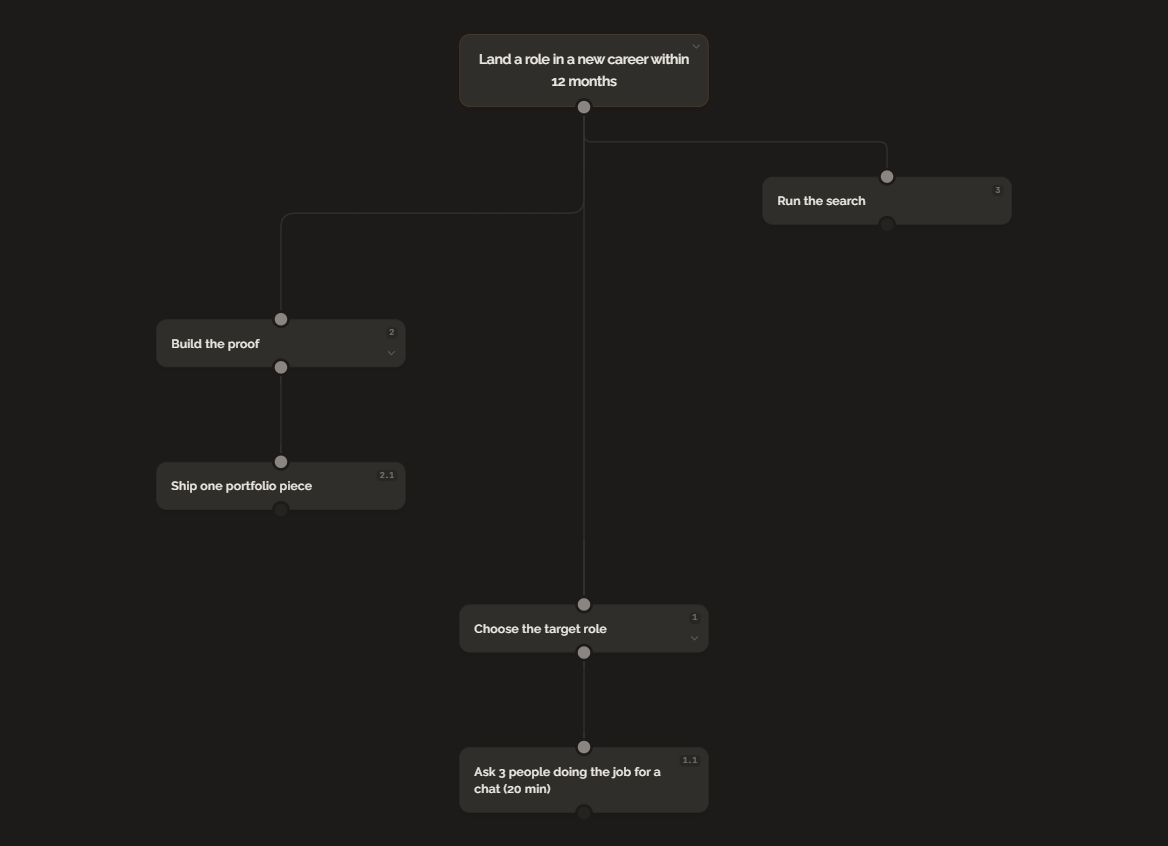
The tree above shows a career change planned backward in GoalBranch. The goal is "Land a role in a new career within 12 months." The three main milestones are:
Choose the target role. Before you can apply anywhere, you need to know which role you are actually targeting. The backward step beneath it is asking three people who already do that job for a short conversation. That is the 20-minute first step at the bottom of the tree.
Build the proof. Once the target is clear, you need evidence that you can do the work. That might be a portfolio piece, a certification, or a project. Each of those can be broken down further.
Run the search. With the target defined and the proof ready, the actual job search begins.
Notice that at every level, the question is the same: what must be true before the next step is possible. That question forces the plan to shrink, because dependencies are real, and they are always smaller than the goal they support.
For more on how this applies to personal goals broadly, read our backward planning guide.
The Bottom Line
Overwhelm is not a character flaw. It is what happens when you have a goal but no structure. Backward planning provides the structure by replacing a mountain of possibilities with one small step. Pick one goal, find the 20-minute step, and do that first.
FAQ
Why do I feel overwhelmed by my goals?
Overwhelm happens when your brain treats every possible next step as equally urgent. Without a structure that shows which steps depend on which, the number of options creates decision paralysis. Backward planning fixes this by revealing the one step that everything else depends on.
How do you break down a goal that feels too big?
Start at the finish line and work backward. Ask what must be true just before the goal is reached, then just before that, until you reach a step you can take today. The example in this post backs a career change down to a single 20-minute conversation.
How many goals should I focus on at once?
One primary goal at a time. The feeling of being overwhelmed often comes from having too many simultaneous targets. Backward planning forces clarity by anchoring everything to a single outcome, which automatically trims the noise.
Ready to try backward planning on your own goals?
Start planning freeMore guides
Vision Board With Goals: Attach a Step to Every Image
Most vision boards show dreams without the steps to reach them. Here is how to attach a backward plan to every image and turn your board into a real roadmap.
Backward Design vs Backward Planning: Same Idea, Different Rooms
Backward design and backward planning share one logic: start at the outcome and work back. One belongs to education, the other to goals. See how they compare.