Can ChatGPT Plan Your Goals? Where It Helps and Where It Stops
ChatGPT writes a solid first draft of a goal plan, then loses it in scrollback. Here is what it does well, where it stops, and what to use alongside it.
TL;DR: ChatGPT is genuinely good at the first draft of a goal plan. Give it "launch a side project" and it returns a sensible step list in thirty seconds. It stops being useful the moment planning becomes an ongoing activity: the plan lives in a chat transcript, it changes every time you ask again, and nothing tracks what you have finished. Use ChatGPT to think. Use a persistent structure, a tree you can see and check off, to act.
The Short Answer
Yes, ChatGPT can plan your goals, and the first draft it writes is usually decent. It breaks a big goal into steps, flags things you had not considered, and answers follow-up questions about any step. What it cannot do is hold that plan: there is no persistent structure, no progress tracking, and a regenerated plan rarely matches the last one.
That split, great at drafting and unable to keep state, decides how you should actually use it. This post walks through both halves honestly, then shows the same goal planned in a chat and in a goal tree so you can see the difference.
Where ChatGPT Genuinely Helps
The blank page. The hardest moment in planning is the first one, when the goal is a feeling and not a list. ChatGPT turns "I want to make money from a side project" into concrete candidate steps faster than any worksheet. That momentum is real value.
Pressure-testing the goal itself. Ask "what usually kills this kind of goal?" and you get a useful list of failure modes before you have committed to anything. A tool that only structures your plan cannot do this; a conversation can.
Explaining unfamiliar steps. When your plan says "validate demand" and you have never validated anything, ChatGPT explains what that means, in your context, at whatever depth you ask for. It is a patient tutor attached to your plan.
Rewriting vague steps into specific ones. Paste in "work on marketing" and ask for a version with a number and a deadline. This is mechanical work it does well and you should not do by hand.
Where It Stops
The plan disappears into scrollback. A chat is a transcript, not a workspace. The step list you got on Tuesday is buried under Thursday's conversation about something else. Memory settings can carry some personal context between chats, but they do not maintain a living plan. By week two, most people are not executing the plan; they are scrolling to find it.
Asking again produces a different plan. Language models generate fresh output on every request. Regenerate your breakdown and steps get renamed, reordered, or silently dropped. For brainstorming, that variety helps. For execution, a plan that mutates every time you look at it is not a plan.
Nothing tracks state. ChatGPT does not know you finished step three. There is no checkbox, no completion percentage, no sense of where you are on the map. You can paste your progress back in and ask for an update, but now you are the database, and that job always gets dropped first.
It plans forward by default. Ask for steps and you get a forward march: step 1, step 2, step 3 from where you stand today. The direction matters. A 2017 study in Psychological Science (Park, Lu, and Hedgcock) found that people who planned backward completed more tasks and reported greater motivation, higher goal expectancy, and less time pressure than forward planners. You can prompt ChatGPT to work backward from the outcome, and you should, but you have to know to ask, and the transcript problem remains either way.
The Honest Capability Table
| Planning task | ChatGPT | A dedicated goal planner |
|---|---|---|
| First draft of a plan, from nothing | Excellent, seconds | Good, generates the tree for you |
| Answering questions about a step | Excellent | Limited or none |
| Pressure-testing whether the goal is realistic | Good | Limited |
| Keeping the plan visible in one place | No, it scrolls away | Yes, that is the product |
| Tracking what is done | No | Yes |
| Breaking down one branch deeper without redoing the rest | No, regenerates everything | Yes |
| Same plan tomorrow as today | No | Yes |
The pattern is clean: ChatGPT wins everything conversational, and loses everything structural. That is not a flaw to fix with better prompts; it is what a chat interface is. If you want the structural column, use a tool built for it. GoalBranch generates the same backward breakdown as a persistent tree you can see, expand branch by branch, and check off, or start from your own draft and see your first step in 60 seconds.
The Same Goal, Twice
Take a real goal: launch a side project to $1,000/month in 6 months.
Ask ChatGPT and you get a competent linear list: pick an idea, validate it, build an MVP, launch, market it. Useful for five minutes, then it starts aging in the transcript.
Here is the same goal as a goal tree:
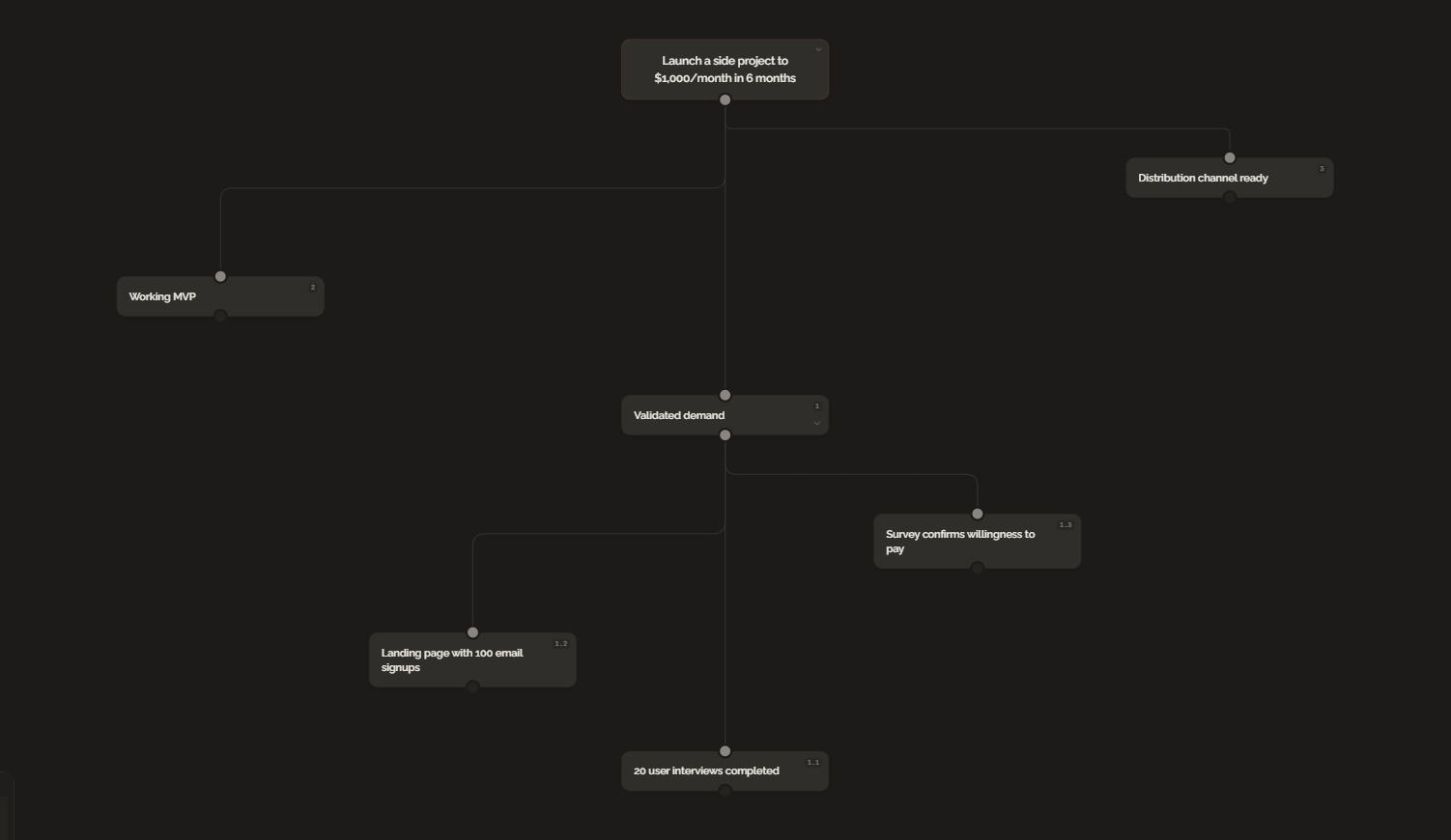
The goal branches into three conditions that must be true: validated demand, a working MVP, and a distribution channel ready. "Validated demand" breaks down further into 20 user interviews completed, a landing page with 100 email signups, and a survey confirming willingness to pay. Every node is checkable, the whole plan is visible at once, and it is identical tomorrow. The first small step falls out of the structure by itself: book user interview number one.
How to Use Both
-
Start the thinking in ChatGPT. Dump the messy version of your dream, ask what usually kills goals like this, and let it argue with you until the goal has a number and a deadline.
-
Ask it to plan backward, not forward. Use the prompt "work backward from [goal]: what must be true right before it's done?" and repeat until the steps are small.
-
Move the plan into a persistent structure. A tree, a board, a document you will actually reopen. This is where chat stops and tools begin; our AI goal planner comparison covers the options, and if your life already runs on Notion, the GoalBranch vs Notion breakdown covers that path specifically.
-
Return to ChatGPT per step, not per plan. When a single step confuses you, ask about that step. Keep the plan itself out of the chat.
The Bottom Line
ChatGPT is the best thinking partner goal planning has ever had, and a bad place to keep the result. Draft in chat, then move the plan somewhere it can hold still and show your progress. Your next move is small: take the plan you already asked ChatGPT for, and give it a permanent home before it scrolls away.
FAQ
Can ChatGPT help with goal setting?
Yes, and it is genuinely good at the start: it drafts a step list for any goal in seconds, pressure-tests whether the goal is realistic, and explains unfamiliar steps. It stops helping once the plan needs to persist, because chat transcripts don't track progress or keep structure.
What is a good ChatGPT prompt for goal setting?
Ask it to plan backward instead of forward: "Work backward from [goal with a number and a deadline]. What must be true right before it's done?" For a goal like launching a side project to $1,000/month in 6 months, that surfaces conditions like validated demand and a working MVP instead of a generic step-one-pick-an-idea list.
Does ChatGPT remember your goals between conversations?
It can carry some personal context between chats depending on your settings, but it does not maintain a living plan. Yesterday's breakdown sits in an old transcript, and asking again produces a new version rather than the one you were working from.
Why does ChatGPT give a different plan every time I ask?
Language models generate a fresh answer on every request rather than retrieving a saved one. For brainstorming that variety is useful; for execution it means your plan quietly mutates each time you ask, so steps get renamed, reordered, or dropped.
Ready to try backward planning on your own goals?
Start planning freeMore guides
Best Goal Planning Apps in 2026 (Free and Paid)
From free habit trackers to AI goal planners, here are the best goal planning apps in 2026 compared by features, pricing, and what they help you do in detail.
Digital Vision Board vs Paper: Which One Sticks?
Digital boards are convenient. Paper boards feel real. Neither turns a vision into a plan. An honest comparison and the fix to make either format work.