Goal Breakdown Worksheet: Turn Any Goal Into a Task List
A free goal breakdown worksheet that turns any goal into an ordered task list instead of a to-do list, with a real kitchen renovation example worked through.
TL;DR: A goal breakdown worksheet turns one goal into a single ordered task list, where each task exists because an earlier task made it possible, not because it felt urgent. Fill in the goal, order the tasks by what depends on what, and start with the first one this week. The example below breaks a kitchen renovation into 10 ordered tasks, starting with a task that takes 20 minutes.
What a Goal Breakdown Worksheet Does
A goal breakdown worksheet takes one goal and turns it into a task list you can actually check off. It does this by asking, for every task, "what has to be true before this one can start?" and placing tasks in that order. The result looks like a normal checklist, but the order is not arbitrary: task 4 comes after task 3 because task 3 unlocks it.
This is also the exact worksheet format used in therapy and coaching contexts, where a goal that feels too big to face gets broken into small, ordered, low-stakes actions. The audience differs, but the mechanism is identical: a goal only becomes doable once it is a list of tasks small enough to start, the same idea behind breaking a big goal into small steps.
The Worksheet
Here is the template. Copy it into a notes app or print it; there's no signup wall in front of it.
GOAL (one sentence, with a number and a deadline):

  _________________________________________________

WHY THIS GOAL MATTERS (one sentence, keeps task 6 worth doing):

  _________________________________________________

TASK LIST (numbered in the order you will actually do them):

  1. _______________________________  unlocks: _______________
  2. _______________________________  unlocks: _______________
  3. _______________________________  unlocks: _______________
  4. _______________________________  unlocks: _______________
  5. _______________________________  unlocks: _______________

FIRST TASK (this week, 20 minutes or less):

  _________________________________________________
Prefer not to fill it in by hand? Generate yours automatically: type the goal and GoalBranch builds the ordered tree behind the list for you.
How to Fill It In
1. Write the goal as one sentence with a number and a deadline. "Renovate the kitchen" is a direction. "Renovate the kitchen for under $15,000 by next June" is a goal a task list can actually serve.
2. Write down why the goal matters, in one sentence. This sounds soft, but it earns its place: task 6 on any real list is tedious, and the "why" line is what keeps you doing it anyway.
3. List the tasks, then reorder them by dependency, not by preference. Write down everything you think the goal needs first, in any order. Then go through the list and ask, for each task, "what does this one need to happen first?" Move it after that task. This step is where a goal breakdown worksheet earns its name: you are breaking the goal apart and then putting it back together in the only order that actually works.
4. Mark what each task unlocks. Next to each task, note the task it makes possible. This turns the list from a pile of things to do into a chain you can trust, and it's the fastest way to spot a task you forgot.
5. Circle the first task and make sure it's small. The first task should take 20 minutes or less. If it doesn't, it's still a milestone wearing a task's costume; break it down one more time.
For the version of this method that shows the tasks as a branching tree instead of a flat list, see the reverse goal setting template and the backward goal setting worksheet. A tree shows the shape of the whole plan; a task list is what you actually check off.
A Real Example: Renovate My Kitchen by Next June
Here is the worksheet filled in for a real goal.
GOAL: Renovate the kitchen for under $15,000 by next June

WHY THIS MATTERS: We host every holiday and the kitchen has been
falling apart for two years.

TASK LIST:
  1. Set the budget cap and hard deadline           unlocks: quotes
  2. Get 3 contractor quotes                         unlocks: choosing one
  3. Choose a contractor and sign a timeline         unlocks: the permit
  4. Apply for the renovation permit                 unlocks: demo
  5. Pick the layout and appliances                  unlocks: ordering
  6. Order cabinets and countertops (8-10 week lead) unlocks: demo timing
  7. Schedule demo week around the delivery date     unlocks: rough-in
  8. Demo and rough-in (plumbing, electrical)         unlocks: install
  9. Install cabinets, countertops, appliances        unlocks: inspection
  10. Final inspection and punch list

FIRST TASK:
  Get 3 contractor quotes (20 min to send the request emails)
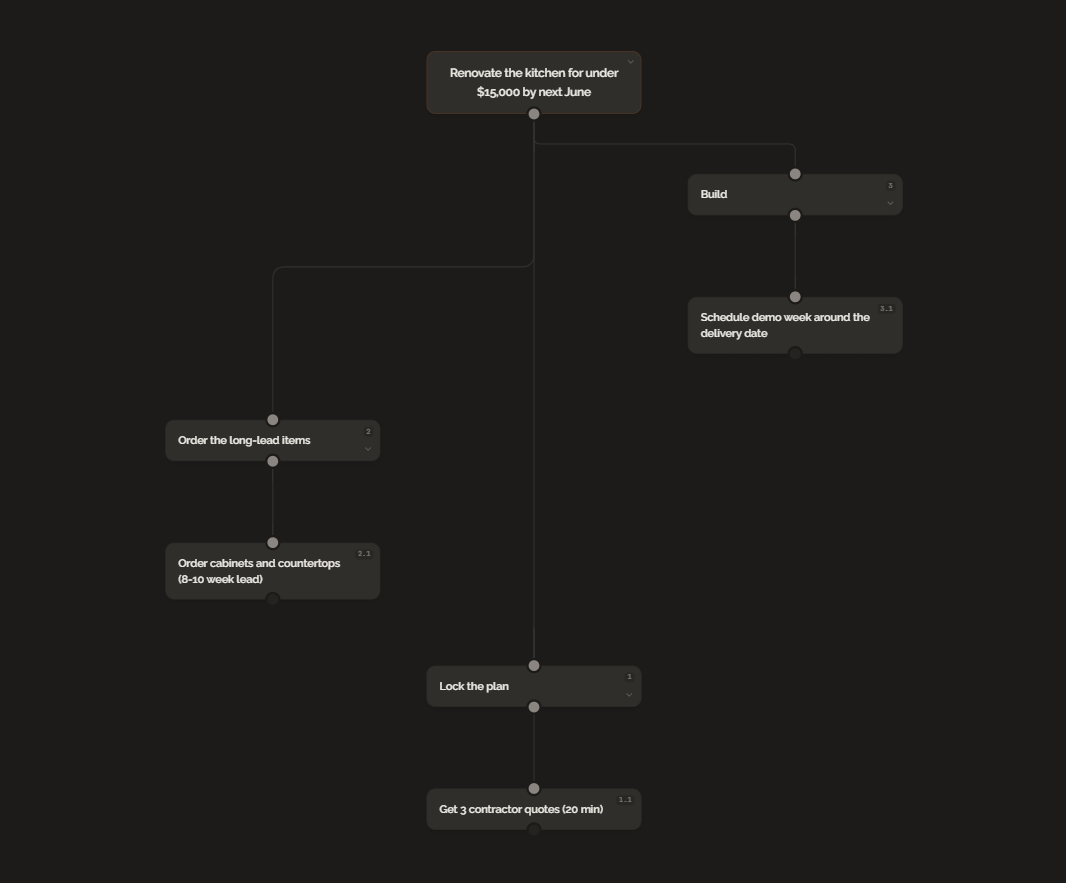
Notice why the order matters. Task 6, ordering cabinets, has an 8-10 week lead time, which is why it happens before the demo is even scheduled: the whole renovation waits on that delivery date, not the other way around. A to-do list would happily let you demo the kitchen first and then discover the cabinets won't arrive for two months. The worksheet catches that before it costs you anything.
Here is the same plan as a GoalBranch tree, which is what generates the ordering behind the list:
Goal Breakdown Worksheets in Therapy and Coaching
Search for this term and you'll find versions built for therapists and coaches, designed to help a client take an overwhelming goal, like repairing a relationship or managing a health condition, and turn it into small, ordered, non-threatening actions. Those versions often add a line for barriers you expect to hit and a note on the target completion date.
The structure is the same worksheet in this guide. If you're using it in a coaching or clinical context, add a barriers line next to each task; naming the obstacle before you reach it is most of what makes the ordering useful in the first place.
Common Mistakes
Ordering by preference instead of dependency. Doing the fun tasks first and leaving the boring ones for later feels natural and produces a list that stalls the moment a real dependency shows up.
Skipping the "unlocks" column. Without it, reordering the list later means re-deriving the whole dependency chain from memory. Writing it down once saves that work every time the plan changes.
Making the first task too big. "Start the kitchen renovation" is not a task; it's the whole goal restated. The first task should be something you could finish on your lunch break.
Never updating the list. A task list is a snapshot of what you know today. When task 6 turns out to need a task 6b, add it and keep going instead of throwing out the list.
The Bottom Line
A goal breakdown worksheet is a to-do list with one rule added: order by dependency, not by preference. Write the goal, list the tasks, reorder them by what unlocks what, and start with whichever one takes 20 minutes. The kitchen renovation above turned a year-long goal into 10 tasks and one task you can start today. Any goal breaks down the same way.
FAQ
What is a goal breakdown worksheet?
A goal breakdown worksheet is a structured page that turns one goal into an ordered list of tasks, each one placed by what has to happen before it, not by what feels urgent today. Therapists and coaches use the same format with clients to make an overwhelming goal feel doable.
What is the difference between a goal breakdown worksheet and a to-do list?
A to-do list collects whatever feels urgent and lets you do it in any order. A goal breakdown worksheet orders tasks by dependency, so task 3 exists because task 2 has to happen first, and you can check the list off top to bottom without hitting a blocker you didn't see coming.
How many tasks should be on a goal breakdown worksheet?
As many as the goal actually requires and no more. The kitchen renovation example in this guide breaks down into 10 tasks; a smaller goal might need 4, and a bigger one might need 20. The count is a symptom of the goal's size, not a target to hit.
Can a goal breakdown worksheet be used for therapy or coaching goals?
Yes. Therapist-facing versions of this worksheet exist specifically to help clients break an overwhelming goal into small, ordered actions, often alongside a note on why the goal matters and what barriers might come up. The structure in this guide works the same way outside a clinical setting.
Ready to try backward planning on your own goals?
Start planning freeMore guides
Reverse Goal Branch Template (Free: Excel, PDF, and Auto-Generated)
A free reverse goal branch template you can copy in one minute, plus a real example that works a big goal backward until the first step takes 20 minutes.
Goal Setting Templates for Students (Free, With a Real Example)
Free goal setting templates for students: a backward planning worksheet, semester tracker, and weekly target sheet. Each includes a worked exam prep example.