Reverse Goal Setting Template (Free, With a Real Example)
A free reverse goal setting template you can copy in one minute, plus a real example that works a big goal backward until the first step takes 20 minutes.
TL;DR: A reverse goal setting template has four layers: the goal (one specific sentence), the milestones (what must be true just before the goal), the branches (what must be true just before each milestone), and the first step (one action under 20 minutes). Copy the template below, fill it top to bottom, and stop breaking steps down the moment one is small enough to do this week.
The Template (Copy It)
A reverse goal setting template is a four-layer structure you fill in from the top: goal, milestones, branches, first step. You start at the finish line and keep asking one question, "what must be true just before this?", until the answer is something you can do this week.
Here is the template. Copy it into any notes app or print this page; there is no signup wall in front of it.
GOAL (the finish line)
  One sentence. Include the number and the deadline if it has one.

MILESTONES (what must be true just before the goal)
  1.
  2.
  3.

BRANCHES (for each milestone: what must be true just before it?)
  Milestone 1:
    -
    -
  Milestone 2:
    -
    -
  Milestone 3:
    -
    -

FIRST STEP (the smallest branch)
  One action, 20 minutes or less, doable today.
Prefer not to fill it in by hand? Generate yours automatically: type the goal and GoalBranch builds the whole tree for you, then lets you expand any branch that still feels too big.
How to Fill It In (5 Steps)
1. Write the goal as one specific sentence. Vague goals produce vague plans. "Get healthy" gives the template nothing to work backward from; "run a 10k in under 60 minutes by May" does. If the goal has a number or a date, include it.
2. List what must be true just before the goal is done. These are your milestones, and three is usually enough. Don't list actions yet; list conditions. Not "train more" but "I can run 8k comfortably."
3. Break each milestone into branches with the same question. For every milestone, ask what must be true just before it. Each answer becomes a branch. This is where reverse planning beats a to-do list: dependencies show up now, on paper, instead of later as blockers.
4. Stop when a step is small enough to do this week. The point of the template is not a complete map of the future. It is finding the one branch small enough to start. If every branch still feels heavy, break the lightest one down once more.
5. Do the smallest branch first. Aim for something under 20 minutes. Momentum comes from finishing a real step that the goal actually needs, not from reorganizing the plan.
A Real Example: "Live 6 Months a Year by the Sea"
Templates make more sense filled in, so here is a real one. The dream: live six months a year by the sea. Filled into the template, it stops being a someday wish and becomes a tree.
GOAL: Live 6 months a year by the sea

MILESTONES:
  1. Earn income I can take anywhere
  2. Find my sea town
  3. Get my monthly costs under control

BRANCHES (Find my sea town):
  - Shortlist 5 coastal towns within my budget
  - Spend a weekend in the top 2
  - Rent there for one full month as a test

FIRST STEP:
  Research winter rental prices in 3 coastal towns (20 min)
Here is the same plan as a GoalBranch tree:
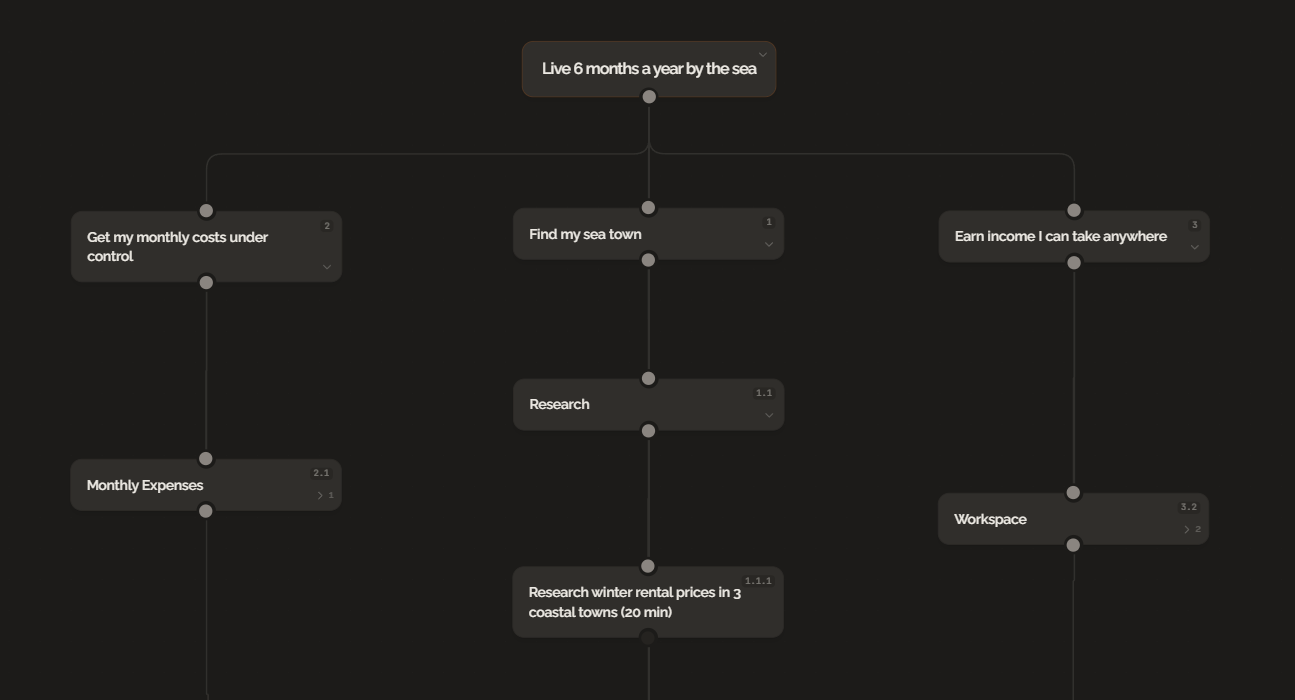
Notice what happened to the size of the steps. The goal is years away. The milestone is months away. The branch is a weekend. The first step is 20 minutes of looking at rental listings, and it is a real piece of the goal, not a warm-up.
Why Working Backward Works
Reverse goal setting is the same method as backward planning; the two names describe one idea, planning from the outcome toward today. A 2017 study in Psychological Science (Park, Lu, & Hedgcock) compared the two directions directly: people who planned backward completed more tasks and performed better, reporting greater motivation, higher goal expectancy, and less time pressure.
The template forces the part most plans skip. Forward plans start with what is easy to start; backward plans start with what the goal requires. If a term in this method is unfamiliar (milestone, goal expectancy, backcasting), the backward planning glossary defines each one in a few sentences.
Common Mistakes With This Template
Filling it in bottom-up. If you start by listing tasks you already wanted to do, you have written a to-do list wearing a template costume. Always start at the goal and work down.
Stopping at the milestone layer. "Find my sea town" is a milestone, not a step. If you cannot start it tomorrow morning, it needs another layer of branches.
Making the first step a planning step. "Research the best planning method" does not count. The first step should move the goal itself, even slightly.
Never revisiting the tree. Plans age. When a branch turns out wrong, redraw that branch, not the whole tree. The goal at the top rarely changes; the path to it often does.
The Bottom Line
A reverse goal setting template is one question applied repeatedly: what must be true just before this? Copy the template, fill in the four layers, and stop when one branch is small enough to do this week. The example above started as a dream measured in years and ended as 20 minutes of rental research. Yours will shrink the same way.
FAQ
What is reverse goal setting?
Reverse goal setting (also called backward goal setting or backward planning) starts at the finished goal and repeatedly asks what must be true just before it, until the remaining steps are small enough to do this week.
What is an example of backward goal setting?
Working backward from "live 6 months a year by the sea": before that you need portable income, a chosen town, and controlled monthly costs. Before choosing a town you need a shortlist, weekend visits, and a one-month rental test. The first step is 20 minutes of rental price research.
How is reverse goal setting different from normal goal setting?
Normal goal setting plans forward from today and tends to start with whatever is easiest to start. Reverse goal setting plans backward from the outcome, so every step is one the goal actually needs and dependencies show up on paper instead of later as blockers.
Do I need an app for reverse goal setting?
No. The template in this article works on paper or in any notes app. An app earns its place when you don't know what the intermediate steps should be, because it can propose the branches for you and let you expand any step further.
Ready to try backward planning on your own goals?
Start planning freeMore guides
Reverse Goal Branch Template (Free: Excel, PDF, and Auto-Generated)
A free reverse goal branch template you can copy in one minute, plus a real example that works a big goal backward until the first step takes 20 minutes.
Goal Setting Templates for Students (Free, With a Real Example)
Free goal setting templates for students: a backward planning worksheet, semester tracker, and weekly target sheet. Each includes a worked exam prep example.