What Is Backcasting? Meaning, Examples, and a Simple Exercise
Backcasting means choosing a specific future you want, then working backward to today's first step. Here is a plain definition, an example, and an exercise.
TL;DR: Backcasting means starting from a specific future you want, then working backward through the stages that connect it to today. It is the opposite of forecasting, which extends current trends forward. The method comes from futures and sustainability research, but it works just as well on a personal goal. This post gives you a plain definition, a forecasting comparison, a five-step exercise, and a worked example you can copy.
Backcasting, Defined
Backcasting is a planning method that starts with a clearly defined future outcome and works backward, stage by stage, to the present. Instead of asking "where do current trends lead?", it asks "if this specific future is the goal, what has to be true just before it, and just before that, all the way back to what I can do today?" The term was coined in 1982 by researcher John Robinson, originally for energy and sustainability planning. The core move is simple: fix the destination first, then let the destination tell you the route.
That reversal is the whole point. Forecasting is a prediction; backcasting is a design. A forecast asks what is likely. A backcast asks what is required. Because it begins at the end state, backcasting surfaces the milestones and dependencies that forward planning discovers too late, which is why it suits goals with long horizons and real uncertainty.
Backcasting vs Forecasting
The two methods answer different questions and run in opposite directions.
| Forecasting | Backcasting | |
|---|---|---|
| Starting point | Today's data and trends | A specific desired future |
| Question it answers | What is likely to happen? | What is required to get there? |
| Direction | Present to future | Future to present |
| Best for | Short horizons, stable conditions | Long horizons, high uncertainty |
| Output | A prediction | A plan of milestones |
Forecasting is the right tool when conditions are stable and you are planning a year or two out. Backcasting earns its keep when the future you want does not look like a straight extension of today, when the gap between here and there is wide enough that trend-following will never close it.
From Sustainability Strategy to Personal Goals
Backcasting grew up in strategy. A city imagining its transport network decades out, a company setting a zero-waste target and reverse-engineering the steps: both start at the end state and work back. The same logic scales down cleanly to one person and one goal. "Backcasting", "reverse goal setting", and backward planning all name the same underlying move, just in different rooms. Our backward planning glossary treats them as synonyms, and the reverse goal setting method post walks through the personal-goal version in depth.
The reason it works on personal goals is the same reason it works in a boardroom: starting at the outcome changes what you notice. A 2017 study in Psychological Science (Park, Lu, and Hedgcock) found that people who planned backward completed more tasks and reported greater motivation, higher goal expectancy, and less time pressure than forward planners.
How to Do a Backcasting Exercise in 5 Steps
You can run this on paper in a few minutes. Each step narrows the future until it becomes a task you can start today.
- Write the future outcome as if it already happened. Pick a specific end state with a date attached, for example "living abroad and working remotely by July 2027", not "move abroad someday". The specificity is what makes a backward chain possible at all.
- Name what has to be true right before that outcome. Stand at the finish line and look one step back. Before you move abroad, your income is stable and your visa is sorted; those become your top-level milestones.
- Work backward one link at a time. For each milestone, ask what it depends on, and keep going until each branch reaches something small. A milestone like "remote income stable" traces back to "first remote client secured", which traces back to a task you could start this week.
- Stop when you hit a 20-minute first step. The last item in each backward chain should be something you can finish in one sitting, like "research visa requirements and target countries". If it still feels heavy, break it down once more.
- Do that first step today. Backcasting only pays off when the smallest branch actually gets touched. The whole plan exists to hand you one concrete action, so take it before the motivation fades.
That last part is the hard one to reach on a blank page. You can do the exercise by hand, or generate your tree automatically and see your first step in 60 seconds.
A Worked Example: Moving Abroad
Here is the exercise run all the way through as a backward tree. The future outcome sits at the top, and each branch works down to a first step you could start today.
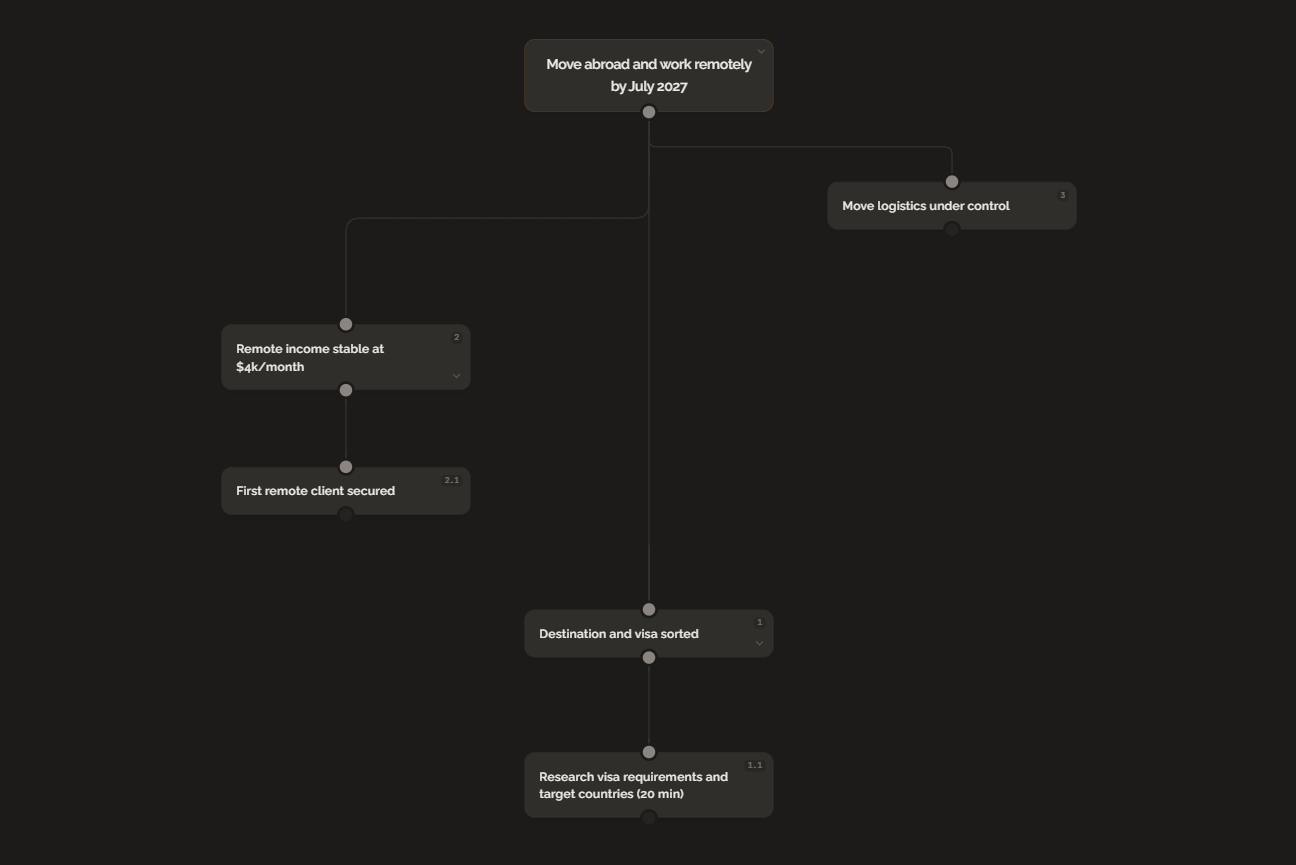
The end state is "move abroad and work remotely by July 2027". Working backward, it splits into three milestones: destination and visa sorted, remote income stable at $4k per month, and move logistics under control. Each milestone then traces to its own first move. "Destination and visa sorted" comes back to a single 20-minute task: research visa requirements and target countries. "Remote income stable" comes back to securing a first remote client. None of these is the whole plan; each is the near end of a branch, which is exactly where you start.
Notice what the backward view surfaces that a forward to-do list hides. Visa lead times and a stable income are not day-one tasks, but they are load-bearing for a 2027 move, so backcasting puts them on the board early instead of letting them ambush you a year in.
The Bottom Line
Backcasting is forecasting turned around: instead of guessing where today's trends lead, you decide where you want to end up and let that destination map the route back to now. It works on a corporate net-zero target and on a plan to move abroad for the same reason, because a clear finish line is a better starting point than a blank page. Pick one future you actually want, work backward until the last step is small, and do that step today.
FAQ
What is backcasting in simple terms?
Backcasting is starting from a specific future you want and working backward through the stages that connect it to today, rather than predicting where current trends will lead. You fix the destination first, then let it map the route.
What is the difference between backcasting and forecasting?
Forecasting extends today's data and trends forward to predict what is likely to happen. Backcasting starts at a desired future outcome and asks what is required to reach it, working from that end state back to the present.
What is an example of backcasting?
A company setting a zero-waste target years out and reverse-engineering the steps is a classic strategic example. On a personal scale, planning to move abroad by a set date and working backward to a first task like researching visa requirements is the same method.
Is backcasting the same as backward planning?
Yes, they are the same method under different names. Backcasting comes from futures and sustainability strategy, while backward planning and reverse goal setting describe the identical move, beginning at the outcome and working back, for everyday and personal goals.
Ready to try backward planning on your own goals?
Start planning freeMore guides
Vision Board With Goals: Attach a Step to Every Image
Most vision boards show dreams without the steps to reach them. Here is how to attach a backward plan to every image and turn your board into a real roadmap.
Backward Design vs Backward Planning: Same Idea, Different Rooms
Backward design and backward planning share one logic: start at the outcome and work back. One belongs to education, the other to goals. See how they compare.