Reverse Goal Setting: The Backward Planning Method Explained
Reverse goal setting means starting at the finish line and working backward. Here is the complete method with real steps and a worked example you can apply today.
TL;DR: Reverse goal setting (also called backward planning) starts at the finish line and works backward. Instead of asking "what should I do next?" you ask "what must be true just before the goal is done?" and repeat until the answer is something small enough to do this week. Five steps: define the outcome, map milestones backward, identify dependencies, build the tree, do the smallest step first.
What Is Reverse Goal Setting?
Reverse goal setting is a planning method where you start with a specific outcome and work backward to identify every step required to reach it. The core question is always the same: "What must be true just before this goal is complete?" Each answer becomes a milestone. You repeat the question on each milestone until the steps shrink to something you can do this week.
The method is also called backward goal setting or backward planning. If the term is new, start with what is backward planning for the full definition.
An old book described the principle decades ago, but the research confirming its edge over forward planning is more recent. A 2017 study in Psychological Science (Park, Lu, and Hedgcock) found that backward planners completed more tasks, reported higher motivation, and felt less time pressure than forward planners.
It differs from forward planning in one critical way. Forward planning starts with today and asks "what comes next?" It builds momentum, but it drifts toward whatever is easy to start. Reverse goal setting starts with the finish line and asks "what must be true?" Every step exists because the goal needs it, not because it was convenient to start there.
Step 1: Define the Outcome With a Number and a Date
A dream is not a goal. Reverse goal setting needs a finish line you can point to.
Weak: "I want to start a side project." Strong: "Launch a side project that earns $1,000/month in recurring revenue within 6 months."
The difference is a number and a deadline. The number forces precision: it turns "a side project" into a measurable outcome. The deadline forces priorities: it tells you which branches matter and which are nice-to-haves that can wait for version 2.
If your goal does not have a number or a date, pick one anyway. Even an estimate is better than a vague direction, because the method only works when every question has a clear answer. "What must be true before launch day" produces real steps. "What must be true before I feel like it" produces nothing.
Step 2: Map the Milestones Backward
Starting from your outcome, ask what must be true just before it. Each answer is a milestone. Work backward through every layer.
Using the side project example:
- Before $1,000/month recurring revenue: 100 paying customers at $10/month each
- Before 100 customers: a working product people can pay for
- Before a working product: a minimum viable version with core features
- Before an MVP: validated demand from at least 20 potential users
- Before validated demand: 20 conversations with people in your target audience
Stop when the milestones reach a point that takes less than a week to act on. "Talk to 20 potential users" is a three-day task, not a milestone. That is where the backward mapping stops and the doing begins.
Step 3: Identify Dependencies
Reverse goal setting surfaces what forward planning hides. As you map backward, dependencies appear naturally:
- You cannot launch a product without a payment processor
- You cannot have 100 customers without a way to reach them
- You cannot validate demand without knowing who to talk to in the first place
Each dependency is a branch that needs its own backward plan. This is the step most planning methods skip. Forward plans list tasks; reverse goal setting reveals what must be true at every level before the level above it can happen. A distribution channel is not a task. It is a milestone that branches into its own sub-steps: content strategy, audience building, partnership outreach.
Step 4: Build Your Tree
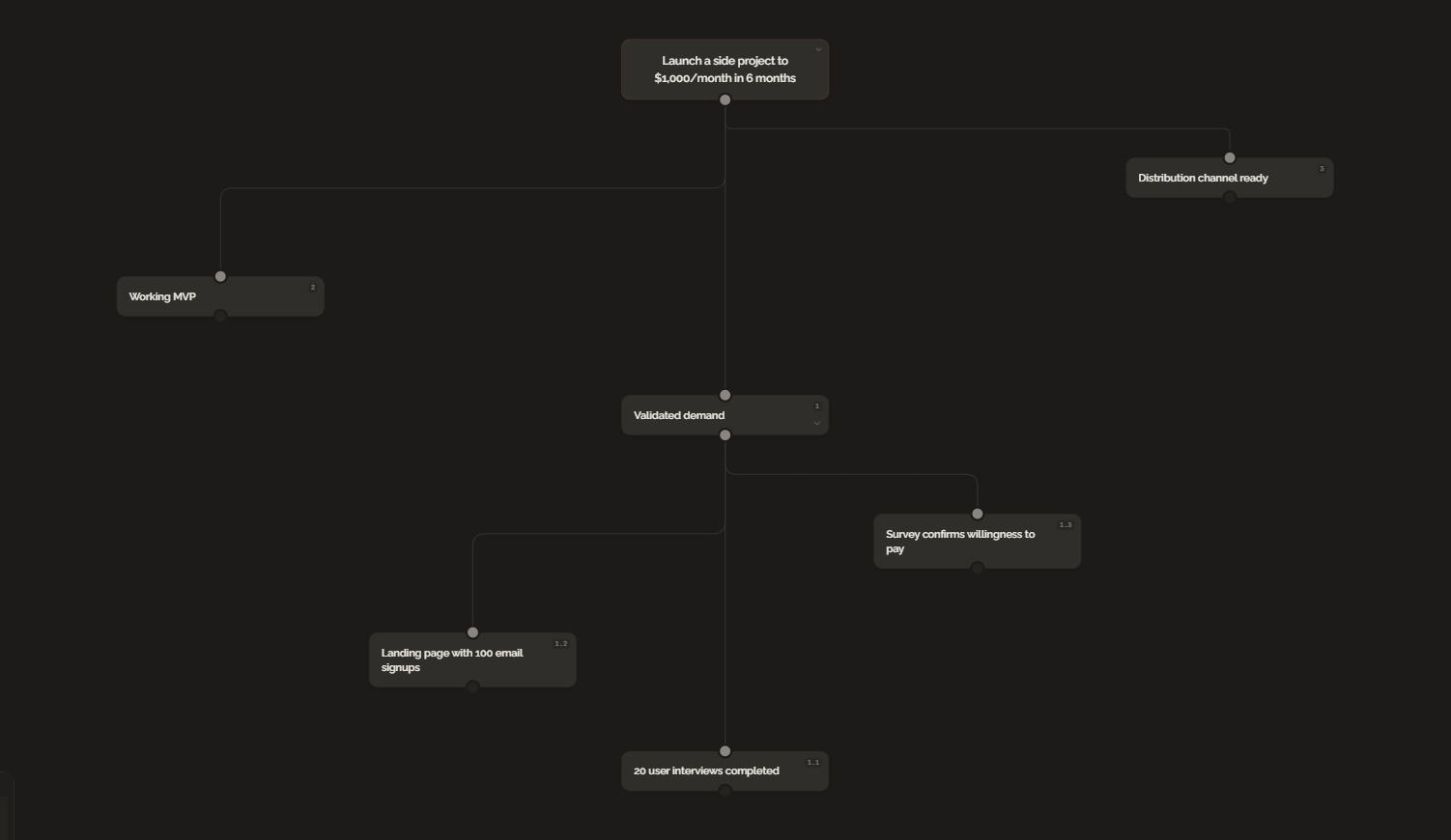
Every milestone and its branches forms a tree. The goal sits at the top. The milestones sit below it. Each milestone branches into its own dependencies. The first step sits at the bottom.
Here is the side project example as a tree:
GOAL: Side project earning $1,000/month in 6 months
  |
  1. Validated demand
  |   - 20 user interviews completed
  |   - Landing page with 100 email signups
  |   - Survey confirms willingness to pay
  |
  2. Working MVP
  |   - Core feature set (3 essential features)
  |   - Stripe checkout integrated
  |   - Hosting and domain set up
  |
  3. Distribution channel ready
      - 500 followers in target audience
      - 3 content pieces published
      - 1 partnership conversation started

  FIRST STEP: List 50 people in your target audience
              and send 5 interview requests today
The tree structure forces one thing that flat lists do not: hierarchy. A milestone and a task cannot live on the same level. If a milestone has no branches beneath it, it is not a milestone. If a branch has no tasks beneath it, it is small enough to start.
Step 5: Execute the First Step and Revisit the Tree
The first step is the smallest actionable piece at the bottom of the tree. Do it this week. When it is done, check the tree. Did the milestone change? Did a dependency turn out differently than expected? Update that branch and find the next smallest step.
Forward planning treats the plan as a script written once and followed blindly. Reverse goal setting treats the tree as a living map. Redraw branches, not the whole tree. The goal at the top rarely changes; the path to it often does.
Tools like GoalBranch generate this tree automatically from a single sentence. You type the goal, it proposes the milestones and branches, and you expand any branch that still feels too big. Generate your tree and see your first step in 60 seconds.
Common Mistakes With Reverse Goal Setting
Starting from today instead of the finish line. If your first milestone is "research tools" instead of "ship to 100 customers," you have written a forward plan in reverse clothing. Always start at the outcome, not at the tasks you already wanted to do.
Stopping at the milestone layer. "Validated demand" is not a step. If you cannot start it tomorrow morning, it needs branches underneath it.
Making the first step a research step. "Read about how to do this" does not count. The first step should move the goal itself, even a millimeter. Five interview requests move a side project. Reading about interview techniques does not.
Never revisiting the tree. A static plan is a historical document. Check the tree weekly, especially in the early weeks. Conditions change, and the branches should change with them. The reverse goal setting template gives you a four-layer structure for doing this on paper or in any notes app.
The Bottom Line
Reverse goal setting is one question applied backward through every layer of a goal: what must be true just before this? The side project example started as a vague wish and ended with 5 messages to send today. Write your goal with a number and a date, apply the question until the answer fits in a week, and start there.
FAQ
What is reverse goal setting?
Reverse goal setting is a planning method that starts with a specific outcome and works backward to identify every step required to reach it. Instead of asking "what should I do next?" you ask "what must be true just before the goal is done?"
How is reverse goal setting different from traditional goal setting?
Traditional goal setting plans forward from today and tends to start with whatever task is easiest. Reverse goal setting plans backward from the outcome, so every step exists because the goal needs it and dependencies show up on paper before they become blockers.
What are the steps of reverse goal setting?
The five steps are: define the outcome with a number and a date, map the milestones backward from the finish line, identify dependencies at each layer, build the full tree of branches, and execute the smallest step first.
Does reverse goal setting actually work?
A 2017 study in Psychological Science found that people who planned backward completed more tasks, reported higher motivation and goal expectancy, and felt less time pressure than those who planned forward.
Ready to try backward planning on your own goals?
Start planning freeMore guides
Vision Board With Goals: Attach a Step to Every Image
Most vision boards show dreams without the steps to reach them. Here is how to attach a backward plan to every image and turn your board into a real roadmap.
Backward Design vs Backward Planning: Same Idea, Different Rooms
Backward design and backward planning share one logic: start at the outcome and work back. One belongs to education, the other to goals. See how they compare.