How to Break Down a SMART Goal (Worked Example)
A SMART goal is a clear finish line, not a plan. Here is how to break a SMART goal into real steps by working backward, shown with a full worked example.
TL;DR: A SMART goal gives you a sharp finish line, but a finish line is not a plan. To break a SMART goal down, start at the goal and work backward: name the milestone that comes right before it, then the milestone before that, until you reach a step you can finish in one sitting. SMART sets the target; backward planning turns it into the next 20 minutes.
To break down a SMART goal, start at the goal and work backward through the milestones that lead to it, then keep splitting each milestone until one step is small enough to finish in about 20 minutes. The SMART framework makes the goal specific, measurable, and time-bound, which is exactly what you need to plan in reverse: a clear target to walk back from. The breakdown itself is a sequence of dependent steps, where each step exists only because the goal requires it.
Why a SMART Goal Still Isn't a Plan
SMART stands for Specific, Measurable, Achievable, Relevant, and Time-bound. It is a quality check for the goal itself. "Get better at Spanish" is not SMART. "Hold a 15-minute conversation in Spanish by June" is. The letters force you to sharpen a wish into something you can actually measure and date.
But a good target is not a route to it. Once your goal passes the SMART test, you still have a blank space between today and the finish line. Most SMART goal guides stop right here, at the writing stage, and hand you a target with no path. That gap is where goals stall.
Breaking the goal down fills the gap. And the most reliable direction to fill it is backward. A 2017 study in Psychological Science (Park, Lu, and Hedgcock) found that people who planned backward completed more tasks and reported greater motivation, higher goal expectancy, and less time pressure than forward planners. Starting from the goal keeps every step tied to the outcome instead of to whatever feels urgent today.
How to Break Down a SMART Goal in Five Steps
The breakdown works the same way for any SMART goal, whether it is an exam score, a savings number, or a launch date. Walk these five steps in order.
-
Confirm the goal is actually SMART. Read your goal and check for a number and a date. "Score 85+ on the June final exam" has both. If yours does not, sharpen it first, because a fuzzy target produces a fuzzy plan no matter how you break it down.
-
Work backward to the milestones. Ask what has to be true right before you hit the goal. That is your last milestone. Then ask what comes before that. A milestone is a checkpoint that takes weeks, not a task you do in an afternoon. Keep going until you have a chain from done back toward today.
-
Break each milestone into branches. Take one milestone and list the sub-goals it needs. Each sub-goal is a branch. Branches are smaller than milestones but usually still too big to do in one sitting. That is fine. You are narrowing the distance, not finishing it yet.
-
Shrink branches until a step takes 20 minutes. Keep splitting a branch until you reach an action you could do on an ordinary Tuesday when you are tired. A real step has a clear start and end and fits in one sentence. If it needs a paragraph to explain, it is still a milestone in disguise.
-
Start the first step. The smallest step at the bottom of the plan is your starting point. It is not a warm-up. It is a real piece of the goal, and everything above it depends on it getting done.
For a deeper look at that shrinking process, our guide on how to break a big goal into small steps walks through the same layers with a different example.
A Worked Example: Score 85+ on the June Final Exam
Take a goal that already passes the SMART test. "Score 85+ on the June final exam" is specific (this subject's final), measurable (85 or higher), achievable, relevant to the grade you need, and time-bound (June). It is a good goal. It is also, right now, just a number on a calendar.
Here is the same goal broken down by working backward.
The three milestones, working backward from the goal:
- Practice under pressure. Sit full past papers to time, so exam day is a repeat, not a surprise.
- A study system. A weekly revision timetable that covers every topic before the practice phase begins.
- Know the exam. Understand what is actually tested and how it is marked, so the study system aims at the right things.
Branches under "know the exam":
- Collect past papers and the official mark scheme
- List the topics that come up most often
- Note the format and timing of each section
The first step that passes the Tuesday test: Get the past papers and the mark scheme (about 20 minutes).
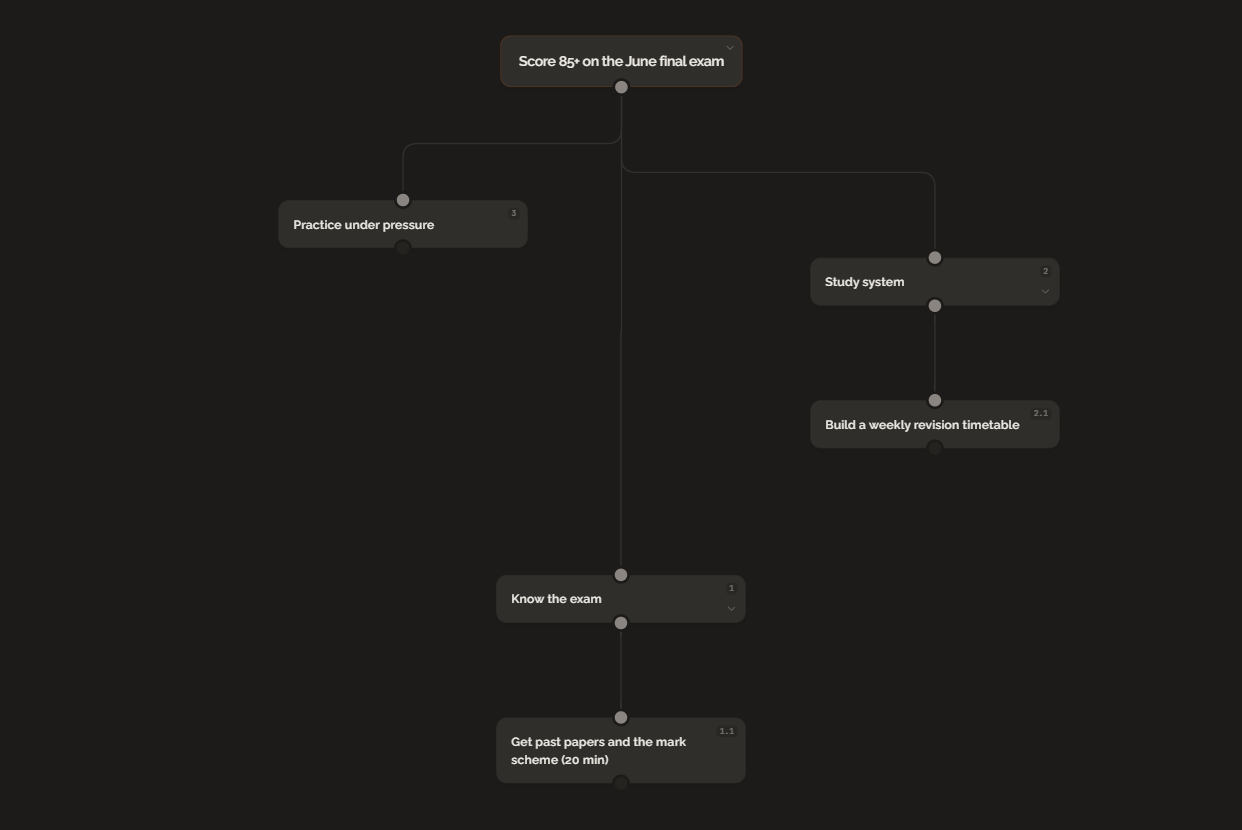
Notice how the pieces change size as you go down. The goal is months away. The milestones are weeks apart. The branches take an evening. The first step takes 20 minutes. The SMART framework gave you the top of that tree; backward planning built the rest of it, all the way down to something you can do tonight.
You can draw this tree by hand, or generate yours automatically in GoalBranch and see your first step in 60 seconds.
Common Mistakes Breaking Down a SMART Goal
Stopping at the SMART wording. Writing the perfect goal statement feels like progress, but a well-worded target with no steps under it is still just a wish with better grammar.
Planning forward from today. Listing what you could start on now tends to surface the easy or familiar tasks, not the ones the goal needs. Backward planning is covered in depth in our what is backward planning guide, and it is what keeps the plan honest.
Making the first step too big. "Start revising" is not a step. "Get the past papers and the mark scheme" is. If you cannot picture yourself finishing it in one sitting, split it again.
The Bottom Line
A SMART goal is a sharp finish line, and that is exactly what makes it easy to plan backward from. Take the target, walk back through the milestones and branches, and stop when one step takes 20 minutes. The goal stays ambitious. The next thing you do gets small enough to start today.
FAQ
What does SMART stand for in goal setting?
SMART stands for Specific, Measurable, Achievable, Relevant, and Time-bound. It describes what a well-defined goal looks like, so you can tell whether a goal is sharp enough to plan before you start breaking it into steps.
Is a SMART goal the same as a plan?
No. A SMART goal is a clear finish line, but it does not tell you the order to do the work. Breaking it down means working backward from the goal through milestones and branches to the first step you can do today.
How do you break a SMART goal into smaller steps?
Start at the goal and ask what has to be true right before you reach it. That is your last milestone. Keep working backward until one step is small enough to finish in about 20 minutes. That step is where you start.
What is an example of a SMART goal broken into steps?
Score 85 or higher on the June final exam breaks into three milestones working backward: practice under pressure, a study system, and knowing the exam. The first step is getting past papers and the mark scheme, about 20 minutes of work.
Ready to try backward planning on your own goals?
Start planning freeMore guides
Vision Board With Goals: Attach a Step to Every Image
Most vision boards show dreams without the steps to reach them. Here is how to attach a backward plan to every image and turn your board into a real roadmap.
Backward Design vs Backward Planning: Same Idea, Different Rooms
Backward design and backward planning share one logic: start at the outcome and work back. One belongs to education, the other to goals. See how they compare.