The Goal Tree Method: Map Any Goal as a Tree (Free Template)
The goal tree method turns one ambition into a visual tree of milestones, branches, and actions. Free template included, or generate yours automatically.
TL;DR: A goal tree is a visual backward plan. You put your goal at the top, then work backward through milestones and sub-goals until every branch ends in an action you can take today. The template below gives you the structure; GoalBranch generates the tree for any goal in 60 seconds.
A goal tree is a diagram that maps the dependency chain between your biggest ambition and the smallest step. It works like a family tree turned upside down: the goal sits at the top, and the milestones, branches, and actions that support it spread downward. Each level answers one question: "what must happen before this can happen?" Moving from top to bottom is backward planning in visual form. A 2017 study in Psychological Science (Park, Lu, and Hedgcock) found that people who planned backward completed more tasks and reported greater motivation, higher goal expectancy, and less time pressure than forward planners. The goal tree makes that logic visible.
How a Goal Tree Works
Every goal tree has four layers. You do not need special software to build one. A piece of paper works, but the structure stays the same whether you draw it by hand or generate it in an app.
Layer 1: The goal. One sentence at the top. It must include a number and a date. "Get in shape" is not a goal for a tree; "run a 10K in under 55 minutes by November" is. The tree collapses if the top is vague.
Layer 2: The milestones. These are the major checkpoints that must happen before the goal is reached. For the 10K goal, the milestones might be: race day performance, peak training phase, base-building phase, and a running assessment. Each milestone is weeks or months of work.
Layer 3: The branches. Each milestone breaks into sub-goals. Under "peak training phase," the branches might include speed work, weekly long runs, cross-training, and a nutrition plan. Each branch is a category of work, not a single action.
Layer 4: The actions. These are the leaves of the tree: single steps you can do in one sitting. Under "speed work," the actions might be: find a track, run 400-meter intervals, log the splits. Each action should pass the Tuesday test: could you do it on an ordinary Tuesday when you are tired?
The Free Goal Tree Template
Here is the structure you can copy and fill in for any goal. Paste this into a document or notebook and work backward from the top.
YOUR GOAL (one sentence, include number and date)
  |
  +-- Milestone 1: [major checkpoint]
  |     +-- Branch: [sub-goal category]
  |     |     +-- Action: [single step]
  |     |     +-- Action: [single step]
  |     |     +-- Action: [single step]
  |     +-- Branch: [sub-goal category]
  |           +-- Action: [single step]
  |           +-- Action: [single step]
  |
  +-- Milestone 2: [major checkpoint]
  |     +-- Branch: [sub-goal category]
  |     +-- Branch: [sub-goal category]
  |
  +-- Milestone 3: [major checkpoint]
        +-- Branch: [sub-goal category]
              +-- Action: [single step]
Fill it in starting from the top. Write the goal first, then the milestones that lead to it, then the branches under each milestone, then the actions under each branch. Every action should take under 30 minutes.
Generate yours automatically in GoalBranch and skip the template filling. Type your goal and see the full tree in 60 seconds.
Four Steps to Build Your Own Goal Tree
Step 1: Lock the Goal
The goal tree needs a single anchor. If you have multiple ambitions, pick one tree per goal. The test is simple: could someone else look at this sentence and know exactly whether you achieved it? If not, add a number and a date until the answer is yes.
Step 2: Name the Milestones Working Backward
Ask: "What must be true right before this goal is reached?" That is your last milestone. Then ask the same question for each milestone. You should end up with three to five milestones that form a chain from the goal back to today.
Step 3: Branch Each Milestone
Each milestone gets its own breakdown. List every sub-goal required to reach that milestone. These are your branches. Most milestones have two to four branches. If a milestone has more than six, it may actually be two milestones.
Step 4: Define Leaves Until They Pass the Tuesday Test
Each branch ends in actions. Keep breaking them down until every action fits in one sentence and takes under 30 minutes. This is where the tree becomes useful: not as a diagram, but as a queue of doable steps.
Real Example: Live Six Months by the Sea
Here is how the same goal tree structure works for a real goal.
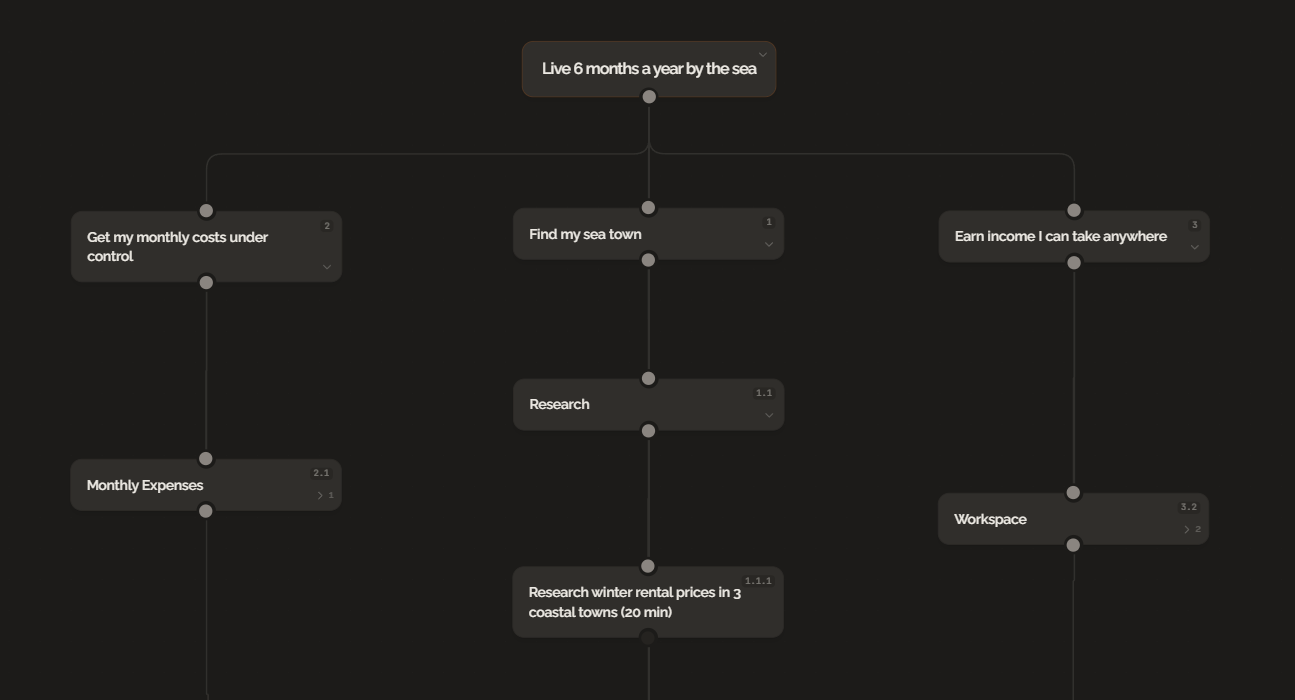
Goal: Live six months a year in a coastal town.
Milestones working backward:
- Earn an income I can take anywhere (remote work or location-independent business)
- Find my sea town (pick a specific place)
- Get my monthly costs under control (save enough to cover the gap)
Branches under "Find my sea town":
- Research coastal towns that fit budget and lifestyle
- Visit two candidates for a trial week each
- Compare rental prices and availability
- Make a decision by a target date
Actions under "Research coastal towns":
- List climate, cost-of-living, and internet-speed criteria (30 min)
- Search towns matching those criteria on nomad forums (20 min)
- Narrow to three candidates
The first action takes 20 minutes. That is where the tree meets the ground. The rest of the tree is a visual reminder that every other step exists only to support the goal at the top.
This same tree shape works for any goal: fitness, career, finance, creative. The goal tree method is a way of thinking, not a fill-in-the-blank. The backward planning glossary has more terms and examples if the tree structure is new to you. For a deeper look at the breakdown process, see how to break a big goal into small steps, which walks through the same five layers with additional examples.
Build your goal tree on paper, in a spreadsheet, or in GoalBranch where you can expand, edit, and rearrange the tree interactively.
The Bottom Line
A goal tree turns a distant ambition into a visual chain of dependencies. Start at the top, work backward through milestones and branches, and keep going until one action takes under 30 minutes. That action is your starting point. The tree will still be there when you finish it.
FAQ
What is a goal tree?
A goal tree is a visual diagram that shows a single goal at the top and all the milestones, sub-goals, and actions required to reach it arranged as branches underneath. Each level answers the question "what must happen before this can happen."
How do you create a goal tree?
Start with your goal at the top. Ask what needs to happen just before that goal is reached. Those are your milestones. Break each milestone into branches, then break each branch into single-sitting actions. Keep working backward until every branch ends in a step you could do on an ordinary Tuesday.
What is the difference between a goal tree and a mind map?
A mind map radiates outward from a central idea to capture related thoughts. A goal tree moves downward from a single objective through layers of dependency. Every node exists because the level above depends on it. A mind map explores; a goal tree plans.
How is a goal tree different from a work breakdown structure?
A work breakdown structure (WBS) decomposes work into deliverables from the top down, typically for projects with known scopes. A goal tree also decomposes from the top down, but it uses backward dependency logic. Each step is a prerequisite for the goal above it.
Ready to try backward planning on your own goals?
Start planning freeMore guides
Reverse Goal Branch Template (Free: Excel, PDF, and Auto-Generated)
A free reverse goal branch template you can copy in one minute, plus a real example that works a big goal backward until the first step takes 20 minutes.
Goal Setting Templates for Students (Free, With a Real Example)
Free goal setting templates for students: a backward planning worksheet, semester tracker, and weekly target sheet. Each includes a worked exam prep example.