Backward Planning vs To-Do Lists: Why Your List Isn't a Plan
A to-do list collects whatever feels urgent. A backward plan contains only what your goal requires. Here is the difference, and how to build a real plan.
TL;DR: A to-do list is a collection of tasks that felt urgent when you wrote them down. A backward plan is a dependency tree grown from a single goal. The difference is structural: one captures whatever comes to mind, the other contains only what the outcome requires. Research shows backward planners complete more tasks, feel less time pressure, and report higher motivation than forward planners. The fix is not a better list. It is a different starting direction.
What a To-Do List Actually Does
A to-do list is a capture tool. You write down emails to send, errands to run, calls to return. It keeps things from falling through the cracks in the short term.
But a to-do list has no organizing principle beyond your attention in the moment. Task A sits next to task B not because A depends on B, but because you thought of both on the same Tuesday afternoon.
This is fine for today's groceries. It breaks down when the goal is ambitious and months away.
What a Backward Plan Does Differently
Backward planning flips the starting point. Instead of asking "what should I do next?", you ask "what must be true right before I reach my goal?" Then you work backward from answer to answer until you are standing at a step you can take today.
The result is a structure where every step has a parent. Nothing is there because it felt urgent. Everything is there because the finish line demands it.
A 2017 study in Psychological Science (Park, Lu, and Hedgcock) found that people who planned backward completed more tasks and reported greater motivation, higher goal expectancy, and less time pressure than forward planners. The direction of planning changed the outcome, not the amount of effort. (The full backward vs. forward comparison covers when each approach works best.)
To-Do List vs Backward Plan: A Side-by-Side Look
Consider the goal "Live 6 months a year by the sea by 2028."
A to-do list approach might look like:
- Research coastal towns
- Talk to my boss about remote work
- Look at real estate websites
- Set up automatic savings
- Declutter the apartment
These are real actions. But they are disconnected. You could research coastal towns without knowing what income you need. You could declutter your apartment months before you know whether you are renting or buying. There is no dependency logic and no way to tell if a task is premature or overdue.
A backward plan approach starts at the outcome and asks "what must be true just before that?"
- Before living by the sea in 2028: I need an income I can take anywhere, a place to stay, and monthly costs under control.
- Before locking in monthly costs: I need to know what my actual spending looks like in a coastal town.
- Before knowing my spending: I need to pick 3 candidate towns and research their rental prices.
- Before researching rental prices: I need to decide what I am willing to spend.
Each step follows from the one above it. Nothing is random.
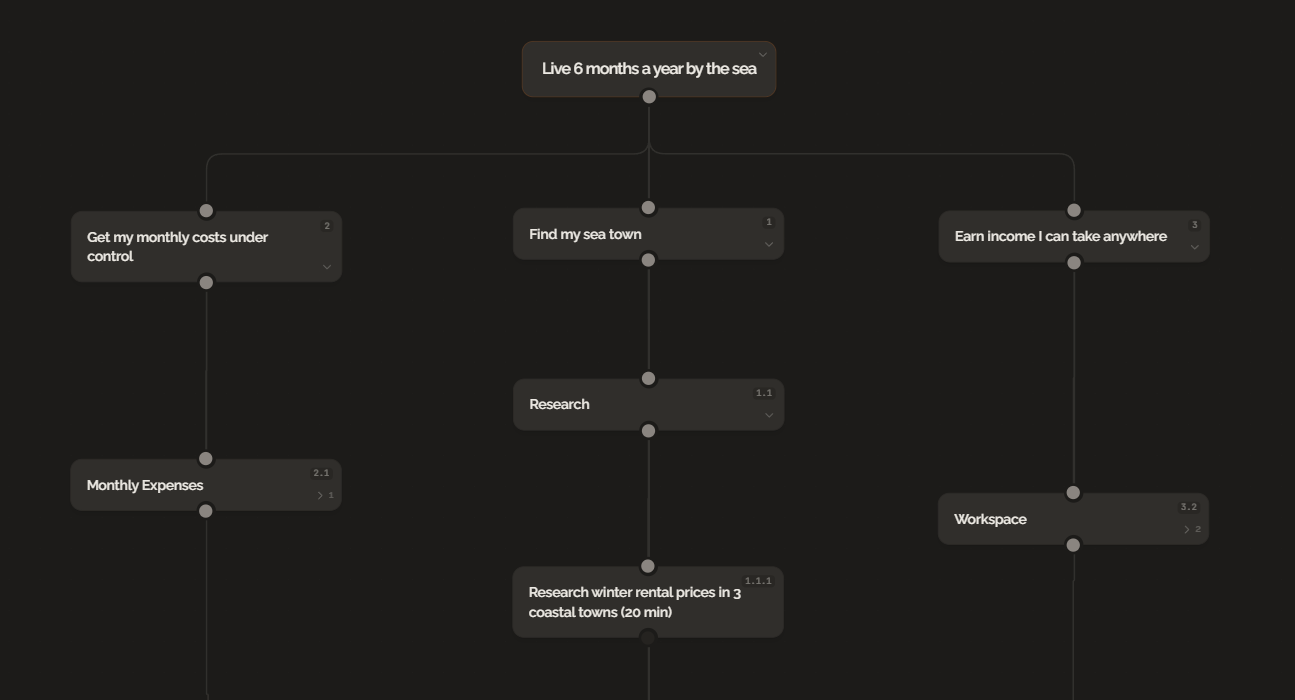
Want this structure without drawing it yourself? Generate your backward plan and see your first step in 60 seconds.
How to Turn Your To-Do List Into a Backward Plan
You do not need to abandon list-making. You need to change the order in which you write the list.
1. Write the goal at the top, not the tasks. Before you write a single action, decide exactly what done looks like. Include a number and a date: "Live 6 months a year by the sea by 2028," not "maybe move somewhere warm someday."
2. Ask what must be true right before the goal. The first answer is your top-level milestone. Write it down.
3. Keep asking "what must be true before that?" Each answer becomes a sub-step. Keep going until you reach something you can do this week.
4. Only then open your to-do list. Everything from the backward plan goes first. Your existing to-do items only stay if they trace back to the goal.
This is how a to-do list becomes a plan instead of a pile.
The Common Trap
The most common mistake is writing the backward plan in the same order as a to-do list. You start with the small, easy tasks because they feel productive. Before you know it, you have a list of comfortable actions that happen to miss the actual dependencies. The steps that unlock everything else (the conversation with your boss, the budget analysis) get skipped because they are uncomfortable.
Backward planning makes you face the hard questions first. That is uncomfortable, but it is also the point.
The Bottom Line
A to-do list is not a plan. It is a pile of tasks sorted by convenience. Backward planning sorts by dependency: what needs to happen so the next thing can happen, all the way up to the outcome you actually want. The difference is not how hard you work. It is where you start.
FAQ
What is the difference between a backward plan and a to-do list?
A to-do list collects tasks that feel urgent or convenient in the moment. A backward plan starts at the desired outcome and works in reverse, so every step exists because the goal requires it, not because it happened to cross your mind.
Can I use a to-do list alongside backward planning?
Yes. Use backward planning to identify the milestones and dependencies first, then forward-plan the daily execution within each milestone. The to-do list becomes a tactical tool within a strategic framework, not the strategy itself.
Why does backward planning work better for ambitious goals than a standard to-do list?
Ambitious goals have dependencies, unknowns, and long timelines that a to-do list cannot capture. Backward planning surfaces those dependencies early, reveals what needs to happen before what, and anchors every task to the outcome rather than to whatever feels urgent today.
Ready to try backward planning on your own goals?
Start planning freeMore guides
Vision Board With Goals: Attach a Step to Every Image
Most vision boards show dreams without the steps to reach them. Here is how to attach a backward plan to every image and turn your board into a real roadmap.
Backward Design vs Backward Planning: Same Idea, Different Rooms
Backward design and backward planning share one logic: start at the outcome and work back. One belongs to education, the other to goals. See how they compare.