Backward Planning in Project Management: 7 Steps + Example
Start at the deadline and schedule in reverse. Seven steps to build a workback schedule, plus a worked example that shows whether your date is realistic.
TL;DR: Backward planning in project management means locking the deadline first and scheduling every task in reverse order from that date. Instead of asking "when will we finish?" you ask "when must we start?" The method reveals hidden dependencies, exposes unrealistic timelines, and protects the end date. This post walks through the steps with a real project example.
Why Fixed Deadlines Need a Different Kind of Plan
Most project plans are built forward. You write down today's date, stack up tasks in chronological order, estimate how long each one takes, and hope the end date lands where you need it. The problem is that forward planning drifts. Early phases run long, and the final phases get compressed. The deadline becomes a hope, not a commitment.
Backward planning flips that logic. You anchor the plan to the deadline and work backward through milestones, dependencies, and task durations until you arrive at a required start date. If that start date has already passed, you know immediately that the scope, resources, or deadline needs to change. You discover this before the project begins, not after the first milestone is missed.
A 2017 study in Psychological Science (Park, Lu, and Hedgcock) found that people who planned backward completed more tasks and reported greater motivation, higher goal expectancy, and less time pressure than forward planners. In project terms, the method works because it forces you to confront constraints early.
Business teams already use backward planning under different names. It is called a workback schedule in product development, reverse planning in event management, and retroplanning in European project offices. The name changes; the logic does not.
Step 1: Lock the Deadline
Write down the final delivery date and confirm it with every stakeholder. If the deadline is soft, it will shift during the project, and so will the plan. A backward plan only works when the end date is fixed.
Weak: "Ship the MVP sometime in Q3" Strong: "Launch the MVP on September 15"
The deadline becomes your anchor. Every decision flows from it.
Step 2: Identify Milestones in Reverse
Starting from the deadline, ask what must happen immediately before it. Then ask what must happen before that. Continue until you reach a milestone you can act on today.
For a product launch on September 15:
- September 15: Public launch
- September 1: Final QA complete
- August 20: Feature freeze
- August 1: Internal beta with 10 testers
- July 15: MVP ready for internal review
- July 1: Core functionality working
Each milestone is a gate. If a milestone slips, you can see exactly which tasks downstream are affected.
Step 3: Estimate Durations Honestly
Duration estimation is where most backward plans introduce their first error. Teams estimate best-case durations and then encounter real-world delays.
For each task between milestones, estimate three numbers: optimistic, most likely, and pessimistic. Use the most likely estimate for the plan and let the pessimistic estimate inform your buffer. If a task has a high uncertainty range, that is where you want your buffer to live.
Step 4: Map Dependencies
List every task and mark what must finish before it can start. These are finish-to-start dependencies, and they form your project's critical path.
Hidden dependencies are what backward planning exposes best. You might discover that you need:
- Legal review before you can publish the pricing page
- Test results before you can write the customer-facing docs
- A hardware order with an 8-week lead time before you can start production
Forward planning often misses these because it builds the timeline from today and discovers the dependency after the lead time has already passed.
Step 5: Identify Parallel Work
Not everything needs to run in sequence. Two tasks with no dependency relationship can run at the same time, which compresses the overall timeline.
For example, writing marketing copy and building the landing page can happen in parallel if the page structure is already defined. Flag these simultaneous tracks in your plan so the timeline reflects the actual concurrency.
Step 6: Add Buffer at Merge Points
Buffer protects the deadline. The right place for buffer is not scattered across every task but concentrated at two points:
- A project buffer between the final task and the actual deadline. Ten to fifteen percent of total project duration is a reasonable starting point.
- Feeding buffers wherever parallel workstreams join. When two independent tracks must both complete before a shared milestone, that merge point is vulnerable. A small buffer prevents a delay in one track from immediately disrupting the other.
Step 7: Calculate Your Start Date
Working backward from the deadline, subtract each task's duration in reverse dependency order. The last date you calculate is the date you need to start.
If today is July 1 and your calculated start date is June 15, you have a problem. The options are: reduce scope, add resources, or move the deadline. You can make that call now, before the team spends weeks building against an impossible timeline.
Real Example: Launching a Side Project
Goal: Launch a side project to $1,000/month in 6 months
This is a concrete project with a deadline, milestones, and dependencies. The backward plan reveals exactly when each phase must start.
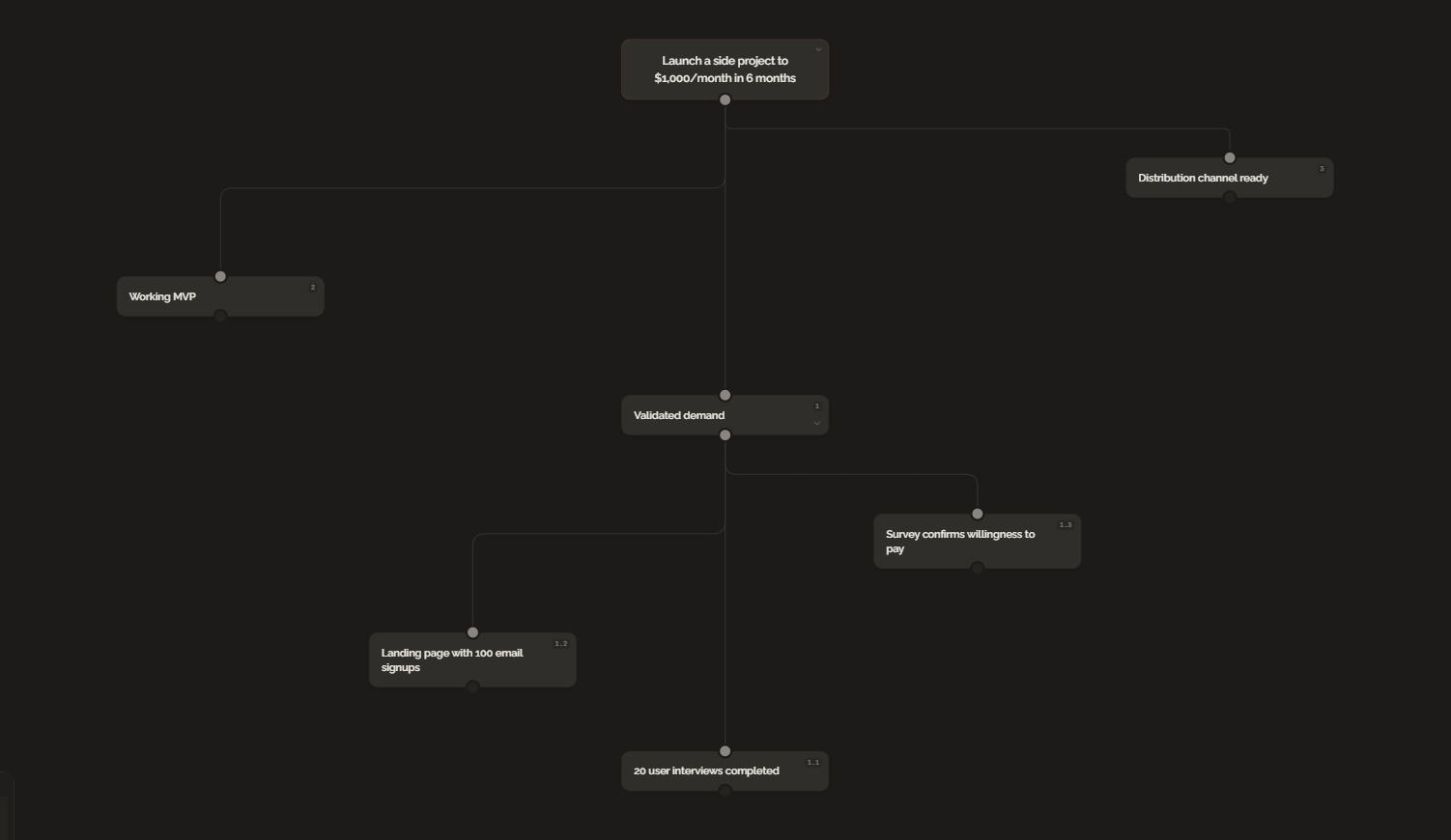
Working backward from month 6:
- Month 6: $1,000/month revenue target
- Month 5: Distribution channel running (content, ads, or partnerships)
- Month 4: MVP live and collecting users
- Month 3: MVP build starts (must know exactly what to build)
- Month 2: Validation complete with confirmed willingness to pay
- Month 1: 20 user interviews done, landing page collecting emails
The tree shows three parallel branches. Validated demand feeds into the MVP scope, which feeds into the distribution work. If validation reveals that nobody will pay, you discover this in month 1, not month 5. That is the value of backward planning in project management. The dependencies surface early enough to act on them. The first step is scheduling those 20 user interviews.
Founders use the same backward planning approach for product launches and revenue milestones, as covered in backward planning for founders. And if you want to see your first step in 60 seconds, generate yours automatically with GoalBranch's tree builder.
The Bottom Line
Fixed deadlines need a planning method that starts at the finish line, not at today. Backward planning in project management works because it reveals what must be true at every stage before the project begins. The first step is always the same: pick one project with a fixed deadline, anchor to that date, and work backward to find your starting point.
FAQ
What is backward planning in project management?
Backward planning (also called a workback schedule or reverse planning) is a scheduling method where you start with the project deadline and work backward to determine what must happen and when. The deadline is fixed; the start date is calculated, not guessed.
When should you use backward planning instead of forward planning?
Use backward planning when the deadline is non-negotiable, such as a product launch, a conference date, a regulatory filing, or any project where missing the date is not an option. Forward planning works better for exploratory projects with flexible timelines.
How is backward scheduling different from forward scheduling?
Forward scheduling starts at today and calculates the earliest possible finish date. Backward scheduling starts at the deadline and calculates the latest possible start date. Both produce the same sequence of tasks, but backward scheduling exposes whether the target date is realistic before the project begins.
What are the steps to create a backward plan for a project?
Start with the fixed deadline. Identify major milestones working backward from that date. Estimate the duration of each task. Map dependencies between tasks. Identify tasks that can run in parallel. Add buffer time at merge points. The last calculated date is your required start date.
Ready to try backward planning on your own goals?
Start planning freeMore guides
Vision Board With Goals: Attach a Step to Every Image
Most vision boards show dreams without the steps to reach them. Here is how to attach a backward plan to every image and turn your board into a real roadmap.
Backward Design vs Backward Planning: Same Idea, Different Rooms
Backward design and backward planning share one logic: start at the outcome and work back. One belongs to education, the other to goals. See how they compare.